'Panem et Circenses'
It was Juvenal (a Roman poet active in the late 1st and early 2nd century AD, author of the Satires) that coined this system, a mechanism of influential power over the Roman masses. "Panem et Circensus", literally "bread and circuses", was the formula for the well-being of the population, and thus a political strategy. (We're well learning all about societal and political strategies today aren't we!)
The Roman formula offered a variety of pleasures such as: the distribution of food, public baths, gladiators, exotic animals, chariot races, sports competition, and theater representation. It was an efficient instrument in the hands of the Emperors to keep the population peaceful, and at the same time giving them the opportunity to voice themselves in these places of performance.
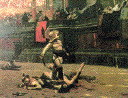 Before the construction of the relative buildings that functioned as the city's central administration, the Forum area was the theater for gladiator combat. These gatherings began at the rise of 122 B.C. Reserved stands for respected spectators were constructed around the piazza (square) of the Roman Forum, excluding the poor classes. Successively, Caio Gracco had these exclusive stands destroyed, winning the favor of the common citizens.
The organization of games was an occasion to climb up the ladder of political popularity: this mechanism degenerated in performances so magnificent that they became "folly", described as such by Lavio.
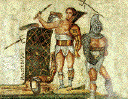 During his youth, Caesar was famous for the magnificent games he organized, as he had hundreds of gladiators fighting each other. His political opponents were worried about the ambitions of this new rival, but he still established a reputation as a generous friend to the public. Caesar organized these games by borrowing a lot of money that was in turn well invested into propaganda earning him important positions in office. Consequently, these positions enabled him to pay back every cent that he had borrowed.
Besides using them as a political strategy, Caesar had a true passion for the games. The people were grateful to him and showered him with honor and positions in large quantities. Caesar is still celebrated as one of the prominent personages of Romanity: it was Caesar that began the Roman Empire.
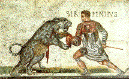 With time the public became more demanding and began organizing performances that were even more costly and magnificent: Octavian Augustus, Caesar's adopted son and prince of Rome, organized "extraordinary" games where 10,000 men battled against 3,500 wild animals from Africa. Also, in 107 A.D., Trajan, on occasion of the victory against the Dacians, organized battles of over 10,000 gladiators that lasted 123 festival days and in which 11,000 wild animals were killed. This record was never to be exceeded, since Trajan walked away from these battles with a sum of 10,000,000 kilos of gold, 20 million kilos of silver, and 500,000 slaves.
The provinces of the empire also had their games that took place in the amphitheaters constructed by the Romans, including: France, Spain, Britain, and all of Italy. The nobility of every city acquired prestige organizing these games and the Roman Empire earned popularity. Of course, only about ten gladiators fought, which was nothing compared to the splendor seen in the city of Rome.
The majority of gladiators were prisoners of war and slaves that were obligated to fight in order to survive. Also, sentenced criminals were brought to the arena to be almost certainly killed by sword -"ad gladium", or by ferocious wild animals- "ad bestias". Rather, the autocrats, who had free choice to fight, scorned danger and were only interested in becoming rich with prizes. Some of them were true popular heroes.
The gladiators were German, Spanish, Welsh, Britannic, black Africans, nomadic Russians, and Jews from Jerusalem. This also had political significance: using the defeated enemy to entertain the public was a triumph in victory.
The wild animals consisted of elephants, tigers, lions, hippopotamuses, gazelles, panthers, camels, wild boars, bulls, deer, leopards, and elks. Only a few of these animals were saved by being sent off to the emperor's zoo, while the rest were cruelly killed.
The gladiators were German, Spanish, Welsh, Britannic, black Africans, nomadic Russians, and Jews from Jerusalem. This also had political significance: using the defeated enemy to entertain the public was a triumph in victory.
The wild animals consisted of elephants, tigers, lions, hippopotamuses, gazelles, panthers, camels, wild boars, bulls, deer, leopards, and elks. Only a few of these animals were saved by being sent off to the emperor's zoo, while the rest were cruelly killed.
The games were often too violent and abusive, like the time when Caligula (37-41 A.D.) sent innocent people from the public to battle because the gladiators were being killed off too fast: the unfortunate had their tongues cut off so they could not yell for help.
The Coliseum, or Flavian amphitheater, was constructed in 70 A.D. in ten years; it was the largest and most magnificent monument dedicated to the games with 50 meters on 4 floors, a diameter of 188 meters, constructed with 100,000 cubic meters of travertine marble and 300 tons of iron, and a capacity with over 50,000 places to sit.
The Circus Maximus was the most grandiose building for public performances ever constructed. Adorned with statues and decorated with noble metals, this place was used for chariot races. 650 meters long by 125 meters wide, it initially had 150,000 places to sit. After the reconstruction that Trajan wanted between 100-104 A.D., available seats expanded to 350,000. Many businesses and stores were located in the Circus Maximus. The races that took place had precise rules that resulted in violence, much appreciated by the public.
But there weren't only violent and cruel performances. The theater was one of the preferred places of the Romans, especially for those looking for a companion. Such was written in 2 B.C. by Ovid in the "Art of Love", an audacious and somewhat obscene book about the tricks for finding a fiance or fleeing from a jealous husband.
In the II century B.C. mimes performed and later were the first playwrights, tragedies, pantomimes, and "canzonettes" (songs).
In the II century B.C. mimes performed and later were the first playwrights, tragedies, pantomimes, and "canzonettes" (songs).
Therefore, much like our society today, the phenomena of stardom, critics, and scandals, want it or not, becomes a part of our lives.
