Friday, August 24, 2012

Friday, August 3, 2012
Interview With Mike Lofgren, Author of "The Party Is Over"
An Interview With Mike Lofgren, Author of "The Party Is Over"

Great article... must read stuff... here's a small excerpt...
"We can devise all the clever schemes imaginable to clean up politics and get money out of campaigns, but it won't work until the American people collectively give up on certain fond illusions: the Horatio Alger myth, American Exceptionalism, and the whole mass of magical thinking that boils down to the belief that God loves America because we're so virtuous, handsome, and smart, and that we, too, could win the lottery. Well, we're not necessarily any of those things. The truth is that we lucked into adverse possession of a mostly empty continent in a temperate zone with lots of resources, and straddled east and west by two huge moats. We had firearms and resistance to smallpox, and the original owners didn't. Virtue had very little to do with it."
Wither or not we pay enough attention in time to shorten the length of serious pain that must come is anyone's guess... but it does not look promising that it's going to be coming anytime soon... not until it can't be avoided any longer..
... and that means it's going to be one hell-of-a-mess!!

Great article... must read stuff... here's a small excerpt...
"We can devise all the clever schemes imaginable to clean up politics and get money out of campaigns, but it won't work until the American people collectively give up on certain fond illusions: the Horatio Alger myth, American Exceptionalism, and the whole mass of magical thinking that boils down to the belief that God loves America because we're so virtuous, handsome, and smart, and that we, too, could win the lottery. Well, we're not necessarily any of those things. The truth is that we lucked into adverse possession of a mostly empty continent in a temperate zone with lots of resources, and straddled east and west by two huge moats. We had firearms and resistance to smallpox, and the original owners didn't. Virtue had very little to do with it."
Wither or not we pay enough attention in time to shorten the length of serious pain that must come is anyone's guess... but it does not look promising that it's going to be coming anytime soon... not until it can't be avoided any longer..
... and that means it's going to be one hell-of-a-mess!!

Thursday, August 2, 2012
Remembering... Forgetting...
“Life has a way of going in circles. Ideally, it would be a straight path forward, we'd always know where we were going, we'd always be able to move on and leave everything else behind. There would be nothing but the present and the future. Instead, we always find ourselves where we started. When we try to move ahead, we end up taking a step back. We carry everything with us, the weight exhausting us until we want to collapse and give up.
We forget things we try to remember. We remember things we'd rather forget. The most frightening thing about memory is that it leaves no choice. It has mastered an incomprehensible art of forgetting. It erases, it smudges, it fills in blank spaces with details that don't exist.
But however we remember it, or choose to remember it, the past is the foundation that holds our lives in place. Without its support, we'd have nothing for guidance. We spend so much time focused on what lies ahead, when what has fallen behind is just as important. What defines us isn't where we're going, but where we've been. Although there are places and people we will never see again, and although we move on and let them go, they remain a part of who we are.
There are things that will never change, things we will carry along with us always. But as we venture into the murky future, we must find our strength by learning to leave things behind.”
― Brigid Gorry-Hines
(...amazing this 19 yo wrote this passage...well beyond her years.)
Sunday, July 15, 2012
... game over ...
In Canada's Tar Sands, a Dante's Hell Threatens People Nearby and Across the Globe
"Canada’s tar sands, deposits of sand saturated with bitumen, contain twice the amount of carbon dioxide emitted by global oil use in our entire history.
If we were to fully exploit this new oil source, and continue to burn our conventional oil, gas and coal supplies, concentrations of carbon dioxide in the atmosphere eventually would reach levels higher than in the Pliocene era, more than 2.5 million years ago, when sea level was at least 50 feet higher than it is now.
That level of heat-trapping gases would assure that the disintegration of the ice sheets would accelerate out of control. Sea levels would rise and destroy coastal cities. Global temperatures would become intolerable.
Twenty to 50 percent of the planet’s species would be driven to extinction. Civilization would be at risk."
"Canada’s tar sands, deposits of sand saturated with bitumen, contain twice the amount of carbon dioxide emitted by global oil use in our entire history.
If we were to fully exploit this new oil source, and continue to burn our conventional oil, gas and coal supplies, concentrations of carbon dioxide in the atmosphere eventually would reach levels higher than in the Pliocene era, more than 2.5 million years ago, when sea level was at least 50 feet higher than it is now.
That level of heat-trapping gases would assure that the disintegration of the ice sheets would accelerate out of control. Sea levels would rise and destroy coastal cities. Global temperatures would become intolerable.
Twenty to 50 percent of the planet’s species would be driven to extinction. Civilization would be at risk."
Saturday, July 7, 2012
What's Going To Happen When The Reality Sets In...
Study predicts imminent irreversible planetary collapse - SFU News - Simon Fraser University

It's been put off for so long because no one saw much of anything happening right around the corner. It was being mentioned about the possibility of it being 100 to 200 years, or more, into the future before telltale signs would begin to be evidenced.
Guess what... now it's more than likely most all living today will be experiencing an ever greater awareness and first-hand knowledge of exactly what's going to be taking place. What was only being talked about will now be happening to all of us.. with increasing and unnerving regularity...
Recently a group of 18 scientists, using scientific theories, toy ecosystem modeling and paleontological evidence as a crystal ball, are now predicting the Earth’s ecosystems are careering towards an imminent, irreversible collapse.
A threshold-induced planetary state-shift is occurring, and it appears more than likely there will be no opportunity for going back. When a system switches to a new state because lots of energy has been added, even if you take out the new energy, it won’t revert back to the old system. The planet doesn’t have any memory of the old state to revert back to.
These projections directly contradict the popularly held belief that the extent to which human-induced pressures, such as climate change, are destroying our planet is still debatable, and any collapse would be both gradual and centuries away. This study concludes that when we have transformed the Earth’s surface by more than 50% we won’t be able to delay, never mind avert, a planetary collapse. We have already reached the 43% mark through converting landscapes into agricultural and urban areas, making Earth increasingly susceptible to an environmental epidemic.
"... gravely underestimating immediacy and danger.. not accurately assessing how rapidly changes are taking place."
“In a nutshell, humans have not done anything really important to stave off the worst because the social structures for doing something just aren’t there,”
" ... those closely studying climate-induced changes through the earth’s history are more than pretty worried... in fact, some state that they are now absolutely terrified.”


It's been put off for so long because no one saw much of anything happening right around the corner. It was being mentioned about the possibility of it being 100 to 200 years, or more, into the future before telltale signs would begin to be evidenced.
Guess what... now it's more than likely most all living today will be experiencing an ever greater awareness and first-hand knowledge of exactly what's going to be taking place. What was only being talked about will now be happening to all of us.. with increasing and unnerving regularity...
 |
| ... global warming wildfires... |
Recently a group of 18 scientists, using scientific theories, toy ecosystem modeling and paleontological evidence as a crystal ball, are now predicting the Earth’s ecosystems are careering towards an imminent, irreversible collapse.
A threshold-induced planetary state-shift is occurring, and it appears more than likely there will be no opportunity for going back. When a system switches to a new state because lots of energy has been added, even if you take out the new energy, it won’t revert back to the old system. The planet doesn’t have any memory of the old state to revert back to.
These projections directly contradict the popularly held belief that the extent to which human-induced pressures, such as climate change, are destroying our planet is still debatable, and any collapse would be both gradual and centuries away. This study concludes that when we have transformed the Earth’s surface by more than 50% we won’t be able to delay, never mind avert, a planetary collapse. We have already reached the 43% mark through converting landscapes into agricultural and urban areas, making Earth increasingly susceptible to an environmental epidemic.
"... gravely underestimating immediacy and danger.. not accurately assessing how rapidly changes are taking place."
“In a nutshell, humans have not done anything really important to stave off the worst because the social structures for doing something just aren’t there,”
" ... those closely studying climate-induced changes through the earth’s history are more than pretty worried... in fact, some state that they are now absolutely terrified.”

... What's Going To Happen When It Is Absolutely Beyond Doubt And Everyone Completely Understands... And How Much Time Do We Really Have...
Tuesday, July 3, 2012
- LivelyHoods -
- LivelyHoods.org -
With all of the troubling news coming at us from every direction today, it's not always easy to see there are some real bright spots. Recently while on twitter, I came across a re-tweet that brought to my attention the name of Maria Springer (@MariaSpringer).
Maria is a wonderful young woman doing her utmost in tying to do some good in this world. She is co-founder and Executive Director of an organization called LivelyHoods. Having grown up in a poor and violent Los Angeles neighborhood herself, she has a passion for social justice and international development. Fresh from college, she was going to sign up for the Peace Corps, but her life took an unexpected turn and dreams of working on a local level to change lives collided… and multiplied… eventually giving rise to LivelyHoods.
LivelyHoods creates jobs to enable unemployed and marginalized youth to work their way out of poverty. The innovative idea is to utilize these youth's survival skills, resourcefulness, and connection to their communities and employ them as sales agents. Building a sales force (iSmart) that helps companies get products into the hands of customers in hard-to-reach urban slums - an untapped and emerging market with exciting potential.
It's this kind of dedication and effort by Maria, along with co-founder, Tania Laden that should be universally recognized and applauded. We have such a monumental need for re-direction at this time... this is an exemplary place to begin... working with the hundreds of thousands of street-youth in Kenya, Africa.
There are over 100 million street kids worldwide, and the number is rising. We can and must break the cycle.

With all of the troubling news coming at us from every direction today, it's not always easy to see there are some real bright spots. Recently while on twitter, I came across a re-tweet that brought to my attention the name of Maria Springer (@MariaSpringer).
Maria is a wonderful young woman doing her utmost in tying to do some good in this world. She is co-founder and Executive Director of an organization called LivelyHoods. Having grown up in a poor and violent Los Angeles neighborhood herself, she has a passion for social justice and international development. Fresh from college, she was going to sign up for the Peace Corps, but her life took an unexpected turn and dreams of working on a local level to change lives collided… and multiplied… eventually giving rise to LivelyHoods.
LivelyHoods creates jobs to enable unemployed and marginalized youth to work their way out of poverty. The innovative idea is to utilize these youth's survival skills, resourcefulness, and connection to their communities and employ them as sales agents. Building a sales force (iSmart) that helps companies get products into the hands of customers in hard-to-reach urban slums - an untapped and emerging market with exciting potential.
It's this kind of dedication and effort by Maria, along with co-founder, Tania Laden that should be universally recognized and applauded. We have such a monumental need for re-direction at this time... this is an exemplary place to begin... working with the hundreds of thousands of street-youth in Kenya, Africa.
There are over 100 million street kids worldwide, and the number is rising. We can and must break the cycle.

Friday, June 22, 2012
... what can any one person really do?
"The world will not be destroyed by those that do evil...
but by those that watch without doing anything."
- Albert Einstein


The situation keeps getting more unpredictable and dire each passing day. You look around what's happening, and say to yourself this is absolutely nuts, but feel powerless to do much to affect any change. To keep on going this way and feel increasingly apathetic is a recipe for ultimate disaster.
So what can you do... wouldn't exactly say it's 'simple'.. but there are a few things:
1. ...of utmost importance ... continually keep educating yourself.
Cannot overemphasize the importance of this first 'to do!' The one way for sure to overcome the tendency to be anxious or fearful of the future, is to learn much more of what is actually happening in the world right now.
You can watch and read mainstream media, but increasingly get more of your information from 'independent news sources' (INS). Subscribe to their feeds and email newsletters (no charge), and then support them financially through voluntary contributions when at all possible. And make it a point that each and every day you will at least spend a minimum amount of time in this pursuit... like anything else, the more time spent, the greater the result.
p.s. - if you only want to start off subscribing to one site.. make it 'Common Dreams'
2. ...with regularity contact your representatives on those issues important to you.
When something really 'gets to you'... don't just bitch and moan to yourself and those immediately around (do that too, but)... find and contact your local representative ..and clearly state your mind. Everyone's got a cellphone.. put the names and contact info for these people in it. Call them (their offices) tell them you want to go on record, and let them know you're either in favor of this.. or you really don't like or want that. A growing chorus of tens of thousands... hundreds of thousands of voices is difficult to silence, and can't forever be ignored.
3. ...ultimately, if you can bring yourself to it... search out, join and get involved with local groups working on specific issues.
This is probably not something that many will jump into right from the start... but there's lots of ways to 'support' those that do get involved. Even just contacting them and letting them know you are on their side is a big morale boost for them. These individuals that are willing to put their bodies 'on-the-line' are real heroes. They don't look at it that way though.. they see as if they have little choice.. and in many ways, they are entirely correct - there are few other alternatives that in the end will enact change.
And again, it's important to support them financially.. one or two dollars multiplied by thousands adds up.. and is critically necessary for them, and for all our future well being.
4. ... set a goal to get at minimum one additional voice involved.
Here's where a 'multiplier effect' has an opportunity to pay HUGE benefits. A turnaround of such magnitude will require an effort beyond anything we have seen before in history. But unless we are able to make this change, the future of all oncoming generations will be fraught with great difficultly, and in all probability will be unbearably harsh.
5. ...fight hard to keep from becoming disillusioned.
The 'system' is unfair and failing...... as all the bad news keeps on mounting up, remaining upbeat and positive will increasingly become more difficult. Again, understand there is no acceptable alternative... stay the course, hope and involvement are our only ways to lead us out from this mess.

"Everyone carries a part of society on
his shoulders; no one is relieved of his share of responsibility by
others. And no one can find a safe way out for himself if society is
sweeping towards destruction. Therefore, everyone, in his own
interests, must thrust himself vigorously into the intellectual battle. None can stand aside with unconcern; the interests of everyone hangs on the results. Whether he chooses or not, every man is drawn into the
greatest historical struggle, the decisive battle into which our epoch
has plunged us."
******

Thursday, May 31, 2012
Reaching 400 .. A VERY Big Deal...
When hitting 400 is not good: Levels of key greenhouse gas pass milestone, trouble scientists.

... across the Arctic this spring monitoring stations are measuring more than 400 parts per million of CO2.
... years ago, it passed 350 ppm mark that many scientists say is the highest safe levelof CO2 in the atmosphere.
... before the Industrial Age, levels were around 275 parts per million.
... been more than 800,000 years since the Earth saw carbon dioxide levels in the 400's.
... entire decade of 2000 to 2009 was warmest on record.
... unlikely the world can achieve the goal of limiting global warming to just 2 degrees celsius based on increasing pollution and greenhouse gas levels.
... further evidence the world’s political leaders, with a few honorable exceptions, are failing catastrophically to address the climate crisis.
... political dynamics in the U.S. mean there’s no possibility of significant restrictions on man-made greenhouse gases no matter what the levels are in the air.
Despite over 20 years of climate stabilization campaigns, the year 2010 saw annual greenhouse gas emissions that were the highest ever recorded. Humanity is in a survival crisis... a crisis of identity, conscience and spirit. Who are we as an evolving species... do we really care more about money than our future generations.
"If humanity wishes to preserve a planet similar to that on which civilization developed and to which life on Earth is adapted, paleoclimate evidence and ongoing climate change suggest that CO2 will need to be reduced from its current level to at most 350 ppm.
If the present overshoot of this target CO2 is not brief, there's probability of seeding irreversible, catastrophic effects."
Survival dictates, there must be a collective spirit stirring millions to rally for more just and equitable societies.

... across the Arctic this spring monitoring stations are measuring more than 400 parts per million of CO2.
... years ago, it passed 350 ppm mark that many scientists say is the highest safe levelof CO2 in the atmosphere.
... before the Industrial Age, levels were around 275 parts per million.
... been more than 800,000 years since the Earth saw carbon dioxide levels in the 400's.
... entire decade of 2000 to 2009 was warmest on record.
... unlikely the world can achieve the goal of limiting global warming to just 2 degrees celsius based on increasing pollution and greenhouse gas levels.
... further evidence the world’s political leaders, with a few honorable exceptions, are failing catastrophically to address the climate crisis.
... political dynamics in the U.S. mean there’s no possibility of significant restrictions on man-made greenhouse gases no matter what the levels are in the air.
400 is extremely significant... "... a depressing reminder to everybody we haven’t fixed this... we’re still in grave trouble.”
“It's an indication we’re now living in a very different world.”
Despite over 20 years of climate stabilization campaigns, the year 2010 saw annual greenhouse gas emissions that were the highest ever recorded. Humanity is in a survival crisis... a crisis of identity, conscience and spirit. Who are we as an evolving species... do we really care more about money than our future generations.
"If humanity wishes to preserve a planet similar to that on which civilization developed and to which life on Earth is adapted, paleoclimate evidence and ongoing climate change suggest that CO2 will need to be reduced from its current level to at most 350 ppm.
If the present overshoot of this target CO2 is not brief, there's probability of seeding irreversible, catastrophic effects."
Survival dictates, there must be a collective spirit stirring millions to rally for more just and equitable societies.
Saturday, May 12, 2012
'Panem et Circenses'
'Panem et Circenses'
It was Juvenal (a Roman poet active in the late 1st and early 2nd century AD, author of the Satires) that coined this system, a mechanism of influential power over the Roman masses. "Panem et Circensus", literally "bread and circuses", was the formula for the well-being of the population, and thus a political strategy. (We're well learning all about societal and political strategies today aren't we!)
The Roman formula offered a variety of pleasures such as: the distribution of food, public baths, gladiators, exotic animals, chariot races, sports competition, and theater representation. It was an efficient instrument in the hands of the Emperors to keep the population peaceful, and at the same time giving them the opportunity to voice themselves in these places of performance.
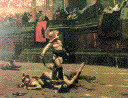 Before the construction of the relative buildings that functioned as the city's central administration, the Forum area was the theater for gladiator combat. These gatherings began at the rise of 122 B.C. Reserved stands for respected spectators were constructed around the piazza (square) of the Roman Forum, excluding the poor classes. Successively, Caio Gracco had these exclusive stands destroyed, winning the favor of the common citizens.
The organization of games was an occasion to climb up the ladder of political popularity: this mechanism degenerated in performances so magnificent that they became "folly", described as such by Lavio.
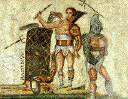 During his youth, Caesar was famous for the magnificent games he organized, as he had hundreds of gladiators fighting each other. His political opponents were worried about the ambitions of this new rival, but he still established a reputation as a generous friend to the public. Caesar organized these games by borrowing a lot of money that was in turn well invested into propaganda earning him important positions in office. Consequently, these positions enabled him to pay back every cent that he had borrowed.
Besides using them as a political strategy, Caesar had a true passion for the games. The people were grateful to him and showered him with honor and positions in large quantities. Caesar is still celebrated as one of the prominent personages of Romanity: it was Caesar that began the Roman Empire.
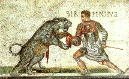 With time the public became more demanding and began organizing performances that were even more costly and magnificent: Octavian Augustus, Caesar's adopted son and prince of Rome, organized "extraordinary" games where 10,000 men battled against 3,500 wild animals from Africa. Also, in 107 A.D., Trajan, on occasion of the victory against the Dacians, organized battles of over 10,000 gladiators that lasted 123 festival days and in which 11,000 wild animals were killed. This record was never to be exceeded, since Trajan walked away from these battles with a sum of 10,000,000 kilos of gold, 20 million kilos of silver, and 500,000 slaves.
The provinces of the empire also had their games that took place in the amphitheaters constructed by the Romans, including: France, Spain, Britain, and all of Italy. The nobility of every city acquired prestige organizing these games and the Roman Empire earned popularity. Of course, only about ten gladiators fought, which was nothing compared to the splendor seen in the city of Rome.
The majority of gladiators were prisoners of war and slaves that were obligated to fight in order to survive. Also, sentenced criminals were brought to the arena to be almost certainly killed by sword -"ad gladium", or by ferocious wild animals- "ad bestias". Rather, the autocrats, who had free choice to fight, scorned danger and were only interested in becoming rich with prizes. Some of them were true popular heroes.
The gladiators were German, Spanish, Welsh, Britannic, black Africans, nomadic Russians, and Jews from Jerusalem. This also had political significance: using the defeated enemy to entertain the public was a triumph in victory.
The wild animals consisted of elephants, tigers, lions, hippopotamuses, gazelles, panthers, camels, wild boars, bulls, deer, leopards, and elks. Only a few of these animals were saved by being sent off to the emperor's zoo, while the rest were cruelly killed.
The gladiators were German, Spanish, Welsh, Britannic, black Africans, nomadic Russians, and Jews from Jerusalem. This also had political significance: using the defeated enemy to entertain the public was a triumph in victory.
The wild animals consisted of elephants, tigers, lions, hippopotamuses, gazelles, panthers, camels, wild boars, bulls, deer, leopards, and elks. Only a few of these animals were saved by being sent off to the emperor's zoo, while the rest were cruelly killed.
The games were often too violent and abusive, like the time when Caligula (37-41 A.D.) sent innocent people from the public to battle because the gladiators were being killed off too fast: the unfortunate had their tongues cut off so they could not yell for help.
The Coliseum, or Flavian amphitheater, was constructed in 70 A.D. in ten years; it was the largest and most magnificent monument dedicated to the games with 50 meters on 4 floors, a diameter of 188 meters, constructed with 100,000 cubic meters of travertine marble and 300 tons of iron, and a capacity with over 50,000 places to sit.
The Circus Maximus was the most grandiose building for public performances ever constructed. Adorned with statues and decorated with noble metals, this place was used for chariot races. 650 meters long by 125 meters wide, it initially had 150,000 places to sit. After the reconstruction that Trajan wanted between 100-104 A.D., available seats expanded to 350,000. Many businesses and stores were located in the Circus Maximus. The races that took place had precise rules that resulted in violence, much appreciated by the public.
But there weren't only violent and cruel performances. The theater was one of the preferred places of the Romans, especially for those looking for a companion. Such was written in 2 B.C. by Ovid in the "Art of Love", an audacious and somewhat obscene book about the tricks for finding a fiance or fleeing from a jealous husband.
In the II century B.C. mimes performed and later were the first playwrights, tragedies, pantomimes, and "canzonettes" (songs).
In the II century B.C. mimes performed and later were the first playwrights, tragedies, pantomimes, and "canzonettes" (songs).
Therefore, much like our society today, the phenomena of stardom, critics, and scandals, want it or not, becomes a part of our lives.
... thoughts on Cuba ...
One of the great parts about blogging is that it is free-flowing... you can keep adding and adapting commentary over time... so check back again for any changes to this post or others to be added.
And some ask... why Cuba? Well, even if it were not for the previous links from the past (two stops while in the Navy at GITMO, and my father's visits to the country when he was a young man... the largest island of the Antilles would still hold a major fascination and be a constant draw. It was a half-century ago that Cuba was the 'Jewel of the Caribbean'.. and still would be if not for cruel fate. It's prominent location smack between the US and South America, and it's resources would have made it a major player in the region.
But all that was not meant to be, and now it's future is again in question.. no one knows what direction it will soon be heading.
Time in Cuba stopped 60 years ago, right at the moments after the revolution.. now everyone is still living with the difficult consequences.. and many are struggling just to get by!!
When you consider this wonderful mind-altering country is only a short 40 minute plane ride away from southern Florida.. (you're over the Keys in a few minutes)... it is unbelievably bizarre!!
Infrastructure
So much needs to be done... most everything is corroding and visibly falling apart.
There's lots that is extreme.. the road system's beyond terrible... especially the eastern portion of the country. Everyone uses the roads together.. trucks, buses, cars, people, bicycles, horse and oxen drawn carts... everyone.. all jockeying for position. Unbelievably, in some locations they even use roads for spreading out and drying their rice crops!!
Most areas you can travel for hours having to avoid bumps and potholes the whole time. Roads across the entire country need to be resurfaced and for sure widened (they're exceptionally narrow). And it would surely be a massive undertaking to redo the road crossing the eastern mountains over to Baracoa.. but it really is totally necessary.
Living Conditions
In one word... dire. Go into what was once a remarkable upscale single family building structure that is now housing two dozen or more families... or out in the countryside view the blocks and blocks of the old soviet-style housing complexes, and you can imagine and dread their living conditions inside.
There's such a small band that most all the population live within... not many existing outside above or below. There's not much visible abject poverty, and not large numbers of those very well off. Even within the most well-to-do neighborhoods many signs of decay are present.
In most every hotel outside the main cities there is no immediate hot water.. it has to be 'turned-on'... and soap and toilet paper is at a premium (hair shampoo mostly non-existent).
The one main positive it the fact that there is absolutely no commercial advertising ANYWHERE... no billboards, no advertisements, no signs.. nothing. The only country in the world so far that we have not seen any commercial advertising.
The People
The Cuban people are most deserved of admiration and credit... other populations having to endure 60 years of harsh one-man rule, coming immediately after another of additional torment, they are truly to be marveled. For they are a vibrant, sincere, and most warm & charming people.
We have much to admire and learn from how they exist together.. it's not perfect, but the way we are trending in our country needs to be reexamined, and looking at they way in which Cubans coexist under what are very demanding conditions provides some much needed perspective.
The Food
Cuban food is among the most vibrant, interesting, flavorful cuisines to be found in the Caribbean. Combining elements of traditional Spain with foods indigenous to the region, Cuban food provides a powerful link to island memories and traditions.
And we did have several exceptionally good meals on the trip (La Guarida was a wonderful restaurant.. should ya ever get to Havana, a must visit)... but on the whole for the entire 12 day journey, it was mostly bland and very boring... the same basic salad of tomato, cucumber, shredded cabbage, and the running joke of canned green beans (awful)... then rice with black beans, and beef, chicken, or pork.. and the occasional nondescript overcooked fish.
These meals were what 'they' thought American tourists would prefer to eat... most of the group increasingly complained, but little got changed. The food at those restaurants that were privately run was the much better product, and prices were exceptionally reasonable at these private restaurants when considering the obvious differences to those state run.
The Culture
Cuban culture enjoys a rich heritage in the field of art, music, literature, and dance. Music in Cuba is influenced by the musical styles of Spain, France, US and Americas.
Music and dancing are a main source of entertainment for most all Cubans, and many important dancing forms such as Salsa have their roots in Cuba.
After lunch dancing at Museo 1514, Trinidad...
... and you can take the tour lecturer-historian (Frank) out of Cuba.... but when he returns.... watch out!!... ;~)
Religion holds an important place in the life of Cubans with main religions being Catholic and Santeria. There is a large arts presence in the country, especially in the major cities.. small private galleries are down many side streets. Music and dance are most everywhere to be found. Baseball is huge.. and cockfighting is prevalent (videos below).
The only newspapers Cubans see are Granma and Juventud Rebelde (Rebel Youth), two staid mouthpieces of the Castro regime.
Internet access is practically nonexistent for the majority of the people. And when there is limited access, going online in Cuba will try the patience of anyone who's ever had a taste of high-speed connections. And according to the government 1 in 6 Cubans were online in 2011, mostly through work or school, and often just to the intranet... at 3-5kb per-second dial-up transfer speeds. The National Statistics Office said last year just slightly less than 3 % reported having direct internet access, though outside experts estimate the real figure is likely 5-10 % accounting for black market sales of dial-up minutes. For a variety of reasons including the 50-year-old U.S. economic embargo, Cuba is the last country in the Western Hemisphere to get a fiber-optic connection to the outside world, and has relied instead on costly and slow satellite linkups.
Satellite television is an unimagined luxury very few can afford... as are cellphones.
On many issues in the country, there is a substantial generational divide in Cuba.. younger Cubans want immediate change. and older generations the status quo, and are uncertain and fearful of what might happen when the Castros no longer hold power.
Economy
Bottom line.. a basket-case. With a majority of the population (80%+) being government employees making the equivalent of $20 dollars a month... everyone is out to try and make additional income. And then most all of this form of 'commerce' is illegal by government definition (but of course they know it exists). Everyone is out to try and 'work the system'.. not to get rich by any means, but just to survive. The GDP of the entire country of 11.5 million is maybe $60-70 billion dollars... and no one is quite sure just how this compares to the size of the 'shadow' economy existing alongside it (which is rapidly growing).
As for agriculture, this is a very large island, with a very large amount of arable land, yet they import a majority of the food stuffs they require, and a third of their beef consumption is imported.
And they would not be able to afford oil they require without substantial subsides from Venezuela.
Government
When governments have an autocratic rule that supersedes the will and well being of their people, it's an absolute recipe for disaster... (be it forms of socialism or crony capitalism). Any state that controls most all businesses is not going to operate a majority of them any where near effectively, and Cuba is no exception. Go to any of the state run restaurants or state operated hotels, then visit their privately run counterparts .. the differences are obvious and numerous, no matter what anyone might be saying to the contrary. As things move forward within a generation big changes could be coming.. no one attempts to say what will happen. And it goes without saying, little will happen until the 'powers' (mainly that reside in southern Florida & in Havana) allow things to change.. another generation or so needs to go by.. burying ghosts... lessening the wounds.
Tourism
Americans are increasingly traveling to Cuba.. but to do it legally you still must go with a group that has a license to visit. This dramatically increases the cost, and restricts who has the means to travel to the country. You can enter on your own from Canada or Mexico but that adds additional travel and expense.
And as it is right now, you are an American you have got to be ready for a 'travel adventure'... not a vacation. The rest of the world might get to relax on the sun drenched shores at the better run resorts.. but Americans are still forbidden to go to any of these locations.
We are not allowed to be 'tourists'... just cultural exchange participants, that are allowed to stray little from the tightly run tour-group itinerary. The exception are those Americans with family ties in Cuba, they are now allowed to pretty much go back and forth freely and do as they will while in the country... bringing with them to Cuba as much as they can reasonably carry (as the chaos at Miami airport reflected when we were going over).
The Military
There is not a large visible 'military' presence across the country, but you get the feeling that it would not be long for one to appear when needed. As an example, for the Pope's recent visit there were a couple thousand 'precautionary arrests' to stifle the possibility of any activists protests. If you would follow any of the Translating Cuba bloggers you can read about what is really taking place 'on the streets.' And following Yoani Sanchez's tweets, you can learn minute to minute what is transpiring... it is fascinating stuff. (Not being able to meet with her as originally talked about prior to our visit was another major disappointment of the trip.)
There is though a good amount of a visible police presence in most all areas of the country, so call them what you will, they are uniformed, well armed, and in all likelihood would ultimately respond completely to the central command running the country (or else).
Cities Visited:
Baracoa
Flew into Holguin early one morning from Miami and took the bus to Baracoa. A very remote location all the way on the eastern portion of the island... cut off by a mountain range to the west. It was a very long drive on one of the most continually bad roads we have ever had the misfortune to traverse.
One of our stops here was to have been a maternity home, but it was cancelled (we were told the government would not allow it). It's a distant part of the country where horses and oxen prevail. Had it not been the location where Columbus first landed, we would in all probability not have visited there.
Santiago
The was no Guantanamo Bay stop as had been indicated in the pre-trip material (a major disappointment). In effect we did nothing but a 'drive-by' from 20 miles away (security reasons was the only explanation given).
The hotel we stayed at in Santiago had no working elevator, the material indicated it was being 'fixed'..when in fact the entire elevator 'system' was in the middle of being completely replaced and would probably have been out for weeks already, and several more to come (the way things function in the country).
Several stops in Santiago were for the most part pleasant, but nothing of particular note.
Camaguay
The historical museum detailed in the itinerary we were to have stopped at was not open. And a stop at a violin workshop had to be postponed till another day.
The hotel was decent.. again no working elevator.. same reason - being replaced. The state must have gotten one massive country wide contract to replace all the outdated elevators across-the-land, for we saw this again and again.. everywhere.
Did unexpectedly go out and get to view several state sanctioned cock-fights...
... (after a 20 minute ride outside the city in a '74 Peugeot, with no windshield)...
... and a full 9 inning playoff series baseball game...
..(absolutely marvelous fan support & sportsmanship.. nothing like the absurd spectacle we now have)..
Sancti Spirtius
Originally the tour had been scheduled to stay in a location just slightly outside of Trinidad along the coast... this was altered last minute to a hotel location in the inland city of Sancti Spirtius, which then necessitated bus ride of 3 hours (total -back and forth) to visit Trinidad.
Both cities were again pleasant stays, but would say without too much hesitation, none on the tour would list either of them as a return 'bucket-list' selection.
Trinidad is pretty much a given 2-day tour stop, as part of a 7-day Cuba tour (Havana, being the other 5 days).
Havana
Largest city in Cuba and its' capital with over 2 million inhabitants.. all in what are basically low-rise very deteriorating structures. It once was for sure the jewel of the Caribbean, attempting to emulate the old world cities of Europe in its' opulence... some of which can still be seen to this day. What an absolute crime it could not have been left to continue on.
It's a gritty, vibrant city... but what will remain in the minds of most, it just how much deterioration it has suffered. Had expected to witness some decay, but major thoroughfares show exactly just how limited are resources in this country to restore the city to its' former grandeur... there is NO money!
And what are purported to be five star hotels, by anyone's standards would be three at best in other parts of the world.. and their pricing is a good proportion higher than it should be considering the quality.
And no discussion of Cuba would be complete without talking about...
The Cars ....
Most all from years prior to the revolution. They just keep getting older and more beat up in most cases (few are gorgeous)... but they keep 'em rollin. These folks have a real talent for swapping parts (and/ or inventing solutions) to put off seemingly forever their demise.
It's a true force of will.. a nation of antique car mechanics.
Might be tempted to again visit the country should things 'open-up' to unrestricted American tourism. But not before several years go by, and that which is much needed to get accomplished...gets done.
We'll just have to wait and see.
Just recently came across this video of old Havana... it really makes you wonder where they would have been today under different circumstances...
PS... To post pix from the trip shortly... been so far working to clear the backlog of reading built up from being away for the couple weeks.
And some ask... why Cuba? Well, even if it were not for the previous links from the past (two stops while in the Navy at GITMO, and my father's visits to the country when he was a young man... the largest island of the Antilles would still hold a major fascination and be a constant draw. It was a half-century ago that Cuba was the 'Jewel of the Caribbean'.. and still would be if not for cruel fate. It's prominent location smack between the US and South America, and it's resources would have made it a major player in the region.
But all that was not meant to be, and now it's future is again in question.. no one knows what direction it will soon be heading.
CUBA Trip - April/May 2012
Time in Cuba stopped 60 years ago, right at the moments after the revolution.. now everyone is still living with the difficult consequences.. and many are struggling just to get by!!
When you consider this wonderful mind-altering country is only a short 40 minute plane ride away from southern Florida.. (you're over the Keys in a few minutes)... it is unbelievably bizarre!!
Infrastructure
So much needs to be done... most everything is corroding and visibly falling apart.
There's lots that is extreme.. the road system's beyond terrible... especially the eastern portion of the country. Everyone uses the roads together.. trucks, buses, cars, people, bicycles, horse and oxen drawn carts... everyone.. all jockeying for position. Unbelievably, in some locations they even use roads for spreading out and drying their rice crops!!
Most areas you can travel for hours having to avoid bumps and potholes the whole time. Roads across the entire country need to be resurfaced and for sure widened (they're exceptionally narrow). And it would surely be a massive undertaking to redo the road crossing the eastern mountains over to Baracoa.. but it really is totally necessary.
Living Conditions
In one word... dire. Go into what was once a remarkable upscale single family building structure that is now housing two dozen or more families... or out in the countryside view the blocks and blocks of the old soviet-style housing complexes, and you can imagine and dread their living conditions inside.
There's such a small band that most all the population live within... not many existing outside above or below. There's not much visible abject poverty, and not large numbers of those very well off. Even within the most well-to-do neighborhoods many signs of decay are present.
In most every hotel outside the main cities there is no immediate hot water.. it has to be 'turned-on'... and soap and toilet paper is at a premium (hair shampoo mostly non-existent).
The one main positive it the fact that there is absolutely no commercial advertising ANYWHERE... no billboards, no advertisements, no signs.. nothing. The only country in the world so far that we have not seen any commercial advertising.
The People
The Cuban people are most deserved of admiration and credit... other populations having to endure 60 years of harsh one-man rule, coming immediately after another of additional torment, they are truly to be marveled. For they are a vibrant, sincere, and most warm & charming people.
We have much to admire and learn from how they exist together.. it's not perfect, but the way we are trending in our country needs to be reexamined, and looking at they way in which Cubans coexist under what are very demanding conditions provides some much needed perspective.
The Food
Cuban food is among the most vibrant, interesting, flavorful cuisines to be found in the Caribbean. Combining elements of traditional Spain with foods indigenous to the region, Cuban food provides a powerful link to island memories and traditions.
And we did have several exceptionally good meals on the trip (La Guarida was a wonderful restaurant.. should ya ever get to Havana, a must visit)... but on the whole for the entire 12 day journey, it was mostly bland and very boring... the same basic salad of tomato, cucumber, shredded cabbage, and the running joke of canned green beans (awful)... then rice with black beans, and beef, chicken, or pork.. and the occasional nondescript overcooked fish.
These meals were what 'they' thought American tourists would prefer to eat... most of the group increasingly complained, but little got changed. The food at those restaurants that were privately run was the much better product, and prices were exceptionally reasonable at these private restaurants when considering the obvious differences to those state run.
The Culture
Cuban culture enjoys a rich heritage in the field of art, music, literature, and dance. Music in Cuba is influenced by the musical styles of Spain, France, US and Americas.
Music and dancing are a main source of entertainment for most all Cubans, and many important dancing forms such as Salsa have their roots in Cuba.
After lunch dancing at Museo 1514, Trinidad...
... and you can take the tour lecturer-historian (Frank) out of Cuba.... but when he returns.... watch out!!... ;~)
Frank's presence and invaluable work on the tour was of huge benefit to all participants. It would not at all have been the same experience without him. We're really looking forward to reading his book - Batista.
Religion holds an important place in the life of Cubans with main religions being Catholic and Santeria. There is a large arts presence in the country, especially in the major cities.. small private galleries are down many side streets. Music and dance are most everywhere to be found. Baseball is huge.. and cockfighting is prevalent (videos below).
The only newspapers Cubans see are Granma and Juventud Rebelde (Rebel Youth), two staid mouthpieces of the Castro regime.
Internet access is practically nonexistent for the majority of the people. And when there is limited access, going online in Cuba will try the patience of anyone who's ever had a taste of high-speed connections. And according to the government 1 in 6 Cubans were online in 2011, mostly through work or school, and often just to the intranet... at 3-5kb per-second dial-up transfer speeds. The National Statistics Office said last year just slightly less than 3 % reported having direct internet access, though outside experts estimate the real figure is likely 5-10 % accounting for black market sales of dial-up minutes. For a variety of reasons including the 50-year-old U.S. economic embargo, Cuba is the last country in the Western Hemisphere to get a fiber-optic connection to the outside world, and has relied instead on costly and slow satellite linkups.
Satellite television is an unimagined luxury very few can afford... as are cellphones.
On many issues in the country, there is a substantial generational divide in Cuba.. younger Cubans want immediate change. and older generations the status quo, and are uncertain and fearful of what might happen when the Castros no longer hold power.
Economy
Bottom line.. a basket-case. With a majority of the population (80%+) being government employees making the equivalent of $20 dollars a month... everyone is out to try and make additional income. And then most all of this form of 'commerce' is illegal by government definition (but of course they know it exists). Everyone is out to try and 'work the system'.. not to get rich by any means, but just to survive. The GDP of the entire country of 11.5 million is maybe $60-70 billion dollars... and no one is quite sure just how this compares to the size of the 'shadow' economy existing alongside it (which is rapidly growing).
As for agriculture, this is a very large island, with a very large amount of arable land, yet they import a majority of the food stuffs they require, and a third of their beef consumption is imported.
And they would not be able to afford oil they require without substantial subsides from Venezuela.
Government
When governments have an autocratic rule that supersedes the will and well being of their people, it's an absolute recipe for disaster... (be it forms of socialism or crony capitalism). Any state that controls most all businesses is not going to operate a majority of them any where near effectively, and Cuba is no exception. Go to any of the state run restaurants or state operated hotels, then visit their privately run counterparts .. the differences are obvious and numerous, no matter what anyone might be saying to the contrary. As things move forward within a generation big changes could be coming.. no one attempts to say what will happen. And it goes without saying, little will happen until the 'powers' (mainly that reside in southern Florida & in Havana) allow things to change.. another generation or so needs to go by.. burying ghosts... lessening the wounds.
Tourism
Americans are increasingly traveling to Cuba.. but to do it legally you still must go with a group that has a license to visit. This dramatically increases the cost, and restricts who has the means to travel to the country. You can enter on your own from Canada or Mexico but that adds additional travel and expense.
And as it is right now, you are an American you have got to be ready for a 'travel adventure'... not a vacation. The rest of the world might get to relax on the sun drenched shores at the better run resorts.. but Americans are still forbidden to go to any of these locations.
We are not allowed to be 'tourists'... just cultural exchange participants, that are allowed to stray little from the tightly run tour-group itinerary. The exception are those Americans with family ties in Cuba, they are now allowed to pretty much go back and forth freely and do as they will while in the country... bringing with them to Cuba as much as they can reasonably carry (as the chaos at Miami airport reflected when we were going over).
The Military
There is not a large visible 'military' presence across the country, but you get the feeling that it would not be long for one to appear when needed. As an example, for the Pope's recent visit there were a couple thousand 'precautionary arrests' to stifle the possibility of any activists protests. If you would follow any of the Translating Cuba bloggers you can read about what is really taking place 'on the streets.' And following Yoani Sanchez's tweets, you can learn minute to minute what is transpiring... it is fascinating stuff. (Not being able to meet with her as originally talked about prior to our visit was another major disappointment of the trip.)
There is though a good amount of a visible police presence in most all areas of the country, so call them what you will, they are uniformed, well armed, and in all likelihood would ultimately respond completely to the central command running the country (or else).
 |
| ...cities visited on our 12-day tour of Cuba... |
Cities Visited:
Baracoa
Flew into Holguin early one morning from Miami and took the bus to Baracoa. A very remote location all the way on the eastern portion of the island... cut off by a mountain range to the west. It was a very long drive on one of the most continually bad roads we have ever had the misfortune to traverse.
One of our stops here was to have been a maternity home, but it was cancelled (we were told the government would not allow it). It's a distant part of the country where horses and oxen prevail. Had it not been the location where Columbus first landed, we would in all probability not have visited there.
Santiago
The was no Guantanamo Bay stop as had been indicated in the pre-trip material (a major disappointment). In effect we did nothing but a 'drive-by' from 20 miles away (security reasons was the only explanation given).
The hotel we stayed at in Santiago had no working elevator, the material indicated it was being 'fixed'..when in fact the entire elevator 'system' was in the middle of being completely replaced and would probably have been out for weeks already, and several more to come (the way things function in the country).
Several stops in Santiago were for the most part pleasant, but nothing of particular note.
Camaguay
The historical museum detailed in the itinerary we were to have stopped at was not open. And a stop at a violin workshop had to be postponed till another day.
The hotel was decent.. again no working elevator.. same reason - being replaced. The state must have gotten one massive country wide contract to replace all the outdated elevators across-the-land, for we saw this again and again.. everywhere.
Did unexpectedly go out and get to view several state sanctioned cock-fights...
... (after a 20 minute ride outside the city in a '74 Peugeot, with no windshield)...
... and a full 9 inning playoff series baseball game...
..(absolutely marvelous fan support & sportsmanship.. nothing like the absurd spectacle we now have)..
Sancti Spirtius
Originally the tour had been scheduled to stay in a location just slightly outside of Trinidad along the coast... this was altered last minute to a hotel location in the inland city of Sancti Spirtius, which then necessitated bus ride of 3 hours (total -back and forth) to visit Trinidad.
Both cities were again pleasant stays, but would say without too much hesitation, none on the tour would list either of them as a return 'bucket-list' selection.
Trinidad is pretty much a given 2-day tour stop, as part of a 7-day Cuba tour (Havana, being the other 5 days).
Havana
Largest city in Cuba and its' capital with over 2 million inhabitants.. all in what are basically low-rise very deteriorating structures. It once was for sure the jewel of the Caribbean, attempting to emulate the old world cities of Europe in its' opulence... some of which can still be seen to this day. What an absolute crime it could not have been left to continue on.
It's a gritty, vibrant city... but what will remain in the minds of most, it just how much deterioration it has suffered. Had expected to witness some decay, but major thoroughfares show exactly just how limited are resources in this country to restore the city to its' former grandeur... there is NO money!
And what are purported to be five star hotels, by anyone's standards would be three at best in other parts of the world.. and their pricing is a good proportion higher than it should be considering the quality.
And no discussion of Cuba would be complete without talking about...
The Cars ....
Most all from years prior to the revolution. They just keep getting older and more beat up in most cases (few are gorgeous)... but they keep 'em rollin. These folks have a real talent for swapping parts (and/ or inventing solutions) to put off seemingly forever their demise.
It's a true force of will.. a nation of antique car mechanics.
Might be tempted to again visit the country should things 'open-up' to unrestricted American tourism. But not before several years go by, and that which is much needed to get accomplished...gets done.
We'll just have to wait and see.
Just recently came across this video of old Havana... it really makes you wonder where they would have been today under different circumstances...
PS... To post pix from the trip shortly... been so far working to clear the backlog of reading built up from being away for the couple weeks.
Saturday, April 14, 2012
Cuba Links - World Affairs Council - April-May 2012
World Affairs Council travel programs offer all the highlights of touring plus access to political leaders and other local experts that give behind-the-scenes views and briefings making trips special and unique. With established connections around the globe allowing them to offer members access they can't get when traveling alone or on other tours.
Trip Leaders:
Dr. Frank Argote-Freyre
Kean University - News Transcript (Comm. on New Americans) - Rate My Professors
An assistant professor of Latin American history at Kean University, Dr. Frank Argote-Freyre received his Ph.D from Rutgers University in 2004. His first book, Fulgencio Batista: From Revolutionary to Strongman was published in 2006. His second book, A Brief History of the Caribbean, coauthored with Danilo Figueredo, came out in January 2008. He is currently working on the second volume of his Batista biography. Prior to embarking on scholarly pursuits, he worked as a journalist for 10 years and as a congressional press secretary. Dr. Argote-Freyre participated in a World Affairs Council of Philadelphia Great Decisions program on Cuba.
Shoshana Altrichter - Associate Director of Travel - WAC (saltrichter@wacphila.org)
With the travel department at the World Affairs Council for over seven years, Shoshana earned a B.A. from Drexel University in Philadelphia. She has led several Council tours including a Ukraine Dnieper River and Black Sea Cruise, a Russia River Cruise, and a cruise to the U.A.E. and a tour to Iran with Ambassador Mark Johnson, a tour to Israel, and a Mekong River Cruise.
Links to articles and information regarding recent Cuba stories:
Dr. Frank Argote-Freyre
Kean University - News Transcript (Comm. on New Americans) - Rate My Professors
An assistant professor of Latin American history at Kean University, Dr. Frank Argote-Freyre received his Ph.D from Rutgers University in 2004. His first book, Fulgencio Batista: From Revolutionary to Strongman was published in 2006. His second book, A Brief History of the Caribbean, coauthored with Danilo Figueredo, came out in January 2008. He is currently working on the second volume of his Batista biography. Prior to embarking on scholarly pursuits, he worked as a journalist for 10 years and as a congressional press secretary. Dr. Argote-Freyre participated in a World Affairs Council of Philadelphia Great Decisions program on Cuba.
Shoshana Altrichter - Associate Director of Travel - WAC (saltrichter@wacphila.org)
With the travel department at the World Affairs Council for over seven years, Shoshana earned a B.A. from Drexel University in Philadelphia. She has led several Council tours including a Ukraine Dnieper River and Black Sea Cruise, a Russia River Cruise, and a cruise to the U.A.E. and a tour to Iran with Ambassador Mark Johnson, a tour to Israel, and a Mekong River Cruise.
Distant Horizons tour escort will be Julie Gilders.
Julie is
fluent in Spanish and she knows Cuba well. She has worked as a
tour manager all around the world. Julie is from the UK and most
recently has led a UK group in Cuba. Julie will meet you at the
arrivals area after you have collected your luggage in Holguin.
Links to articles and information regarding recent Cuba stories:
- Article on Castro’s autobiography – February 2012
- Generation Y blog - Yoani Sánchez
- Yoani Sánchez - Wikipedia
- Translating Cuba - Cuban bloggers – English
- Granma International - Cuba’s principal newspaper
- Amnesty International - Authorities prevent activists commemorating death of dissident
- Cuba’s economic restructuring- Havana Times
- Growth of private work force (link not working)
- Slow reform process - AJ (video)
- Cuba’s oil rig causing concerns. - Journal Gazette
- People-to-People Travel to Cuba - NYT Travel
- Oldest person in the world a Cuban woman? - Fox News Latino
- Pope Benedict’s visit to Cuba - Reuters
- Fidel Castro's jab at Obama - (Fox News Latino) for planning to wear designer guayaberas to a meeting of the Organization of American States while still resisting Cuba's participation at the meeting
- Seattle Times - Ozzie Guillen, manager of the Miami Marlins, insults fan base praising Fidel Castro
- Cuban Slap on the Wrist: The Alan Gross Case
- US senators meet Cuba's Castro about contractor
- Reaching Out to the Cuban People - The White House
- Obama and Castro - Council on Foreign Relations
- Cuban Leader Proposes Term Limits - NYT
- State Department Background Note on Cuba
- Cubans open their doors to small business - LA Times
- Split over Cuba could sink Summit of Americas - Salt Lake Tribune
- Cuban Business Report - Havana Journal
- ... tough lesson about Cuba’s exiles.. ..it will probably not be until all the ghosts are buried that a rebirth can happen...
- 32 - 2... "there will not be another summit without Cuba"
- A generational divide widens in Cuba - Seattle Times
Articles Received In Previous WAC Mailing:
- Old Havana Declines To Die - NYT
- Cuba Unleashes Pent-Up Energy of Real Estate Dreams - NYT
- Give Guantanamo Back to Cuba - NYT
- Cuba Takes Lead Role in Haiti Cholera Fight - NYT
- Will Washington or Havana Move Toward Warmer Relations? - Inter-American Dialogue
- Cuban Leader Proposes Term Limits in Sign of New Era - NYT
- In a Changing Cuba, Many Remain Skeptical - NYT
- Dilma in Cuba - Inter-American Dialogue (IAD)
- Does Brazil's Rousseff Care Enough About Cuban Democracy? - IAD
- An Airlift, Family by Family, Bolsters Cuba's Economy - NYT
- Relenting on Car Sales, Cuba Turns Notorious Clunkers Into Gold - NYT
- Cuban Official Rules Out Reforms Urged by Pope - NYT
- Pope criticizes US trade embargo - BBC
- Falling for Cuba - National Geographic
Additional Issues:
- Social Problems - Prostitution in Cuba - Swedish Model
- TED Case Study
- Jineteras in Cuba
- Cuba Follows Swedish Model to Combat Prostitution
- Will the Real Terrorist Please Stand Up This documentary chronicles half a century of hostile U.S.-Cuba relations. The film highlights decades of assassinations and sabotage at first backed by Washington, then ignored by the very government that launched a "war against terrorism."

saltrichter@wacphila.org has sent you the following via YouSendIt
************
"The
greatest reward and luxury of travel is to be able to experience
everyday things as if for the first time... to be in a position in which
almost nothing
is so familiar it is taken for granted."
is so familiar it is taken for granted."
Saturday, March 31, 2012
...hard to grasp how significant this is...
www.anthropocene.info
"The 'eyes of the future' are looking back at us...
... and they are praying for us to see beyond our own time."
Saturday, March 24, 2012
August 2013 - Black Sea Cruise
OK.. been looking for a Black Sea cruise since we came off the last sea voyage in Istanbul last year. So... we went on-line and made a tentative commitment (cabin 8063) for this cruise next year.
Azamara Club Cruises is a new cruise line for us... we'll see how it goes... their parent company is Oceania. They're identical in style to Regent, another Oceania line, with which we are very familiar.
...click-on for details and to book
(from August 18th, 2013 to August 30th, 2013)
(from August 18th, 2013 to August 30th, 2013)

Voyage Summary
A terrific opportunity to explore the Black Sea in some depth, with stops along Turkey’s Northern Coast, Georgia, and Russia. It also includes Ukraine and Romania, with optional overland trips to history-rich Kiev and Bucharest. Along your voyage route, join optional Land Discoveries to Safranbolu, a well-preserved Ottoman Empire town, and to the cliff-hanging Sümela Monastry and Kackar Mountains. You’ll also visit the charming resort town of Batumi, and Sochi, the site of the 2014 Winter Olympics.
There is only one 'at sea' day, and of all the ports to be visited, only Istanbul is one we have previously visited... for us, this is exactly our kind of cruise itinerary... many new & interesting destinations, with minimal at sea time!!
Cruise Itinerary
DATE PORT/ CITY ACTIVITY- ARRIVAL - DEPARTURE
Sunday, August 18 Istanbul - Turkey Embark 5:00 PM
Monday, August 19 Amasra / (Safranbolu) - Turkey Tendered 9:00 AM 9:00 PM
Tuesday, August 20 At Sea Cruising
Wednesday, August 21 Trabzon - Turkey Docked 7:00 AM 6:00 PM
Thursday, August 22 Batumi - Georgia Docked 7:00 AM 6:00 PM
Friday, August 23 Sochi - Russia Docked 7:00 AM 8:00 PM
Saturday, August 24 Novorossiysk - Russia Docked 7:00 AM 5:00 PM
Sunday, August 25 Yalta - Ukraine Docked 8:00 AM 10:00 PM
Monday, August 26 Sevastopol - Ukraine Docked 8:00 AM 5:00 PM
Tuesday, August 27 Odessa - Ukraine Docked 7:00 AM 11:59 PM
Wednesday, August 28 Constanta - Romania Docked 1:00 PM 8:00 PM
Thursday, August 29 Nessebar - Bulgaria Tendered 8:00 AM 4:00 PM
Friday, August 30 Istanbul - Turkey Debark 6:00 AM
_____________________________________________________
Azamara - 'Journey'
(different cruise... but the video gives an idea of life onboard Journey)
(different cruise... but the video gives an idea of life onboard Journey)
Azamara Club Cruises fleet (Journey & Quest are sister ships) is a new cruising option available to passengers who prefer the boutique-hotel atmosphere of a smaller ship without the luxury-class price tag.
- Seven classes of staterooms are offered onboard Journey. The exclusive experience includes butler service in suites and concierge-style amenities in all categories of accommodations. (Want to book a shore excursion or get a reservation in the special restaurants? Just tell the butler what you want, no forms to fill in or lines to wait in. Want a full dinner from the dining room menu served course by course in your stateroom? The butler will do it.)
- All suite guests receive complimentary chilled soda, bottled water and two bottles of hard liquor at no extra cost. A chilled bottle of champagne is set in the room before embarkation. Complimentary wine is available by room service at any time.
- A self-service launderette (with flat-screen television and upholstered armchairs) is available.
- One pool sits on the center of the ship, surrounded by a designated jogging track on the deck directly above.
- Two specialty restaurants, a main dining room, and a handful of light food and casual dining areas offer a variety of dining options..to include a casual sidewalk cafe-style coffee bar. (The dress code is always resort casual with no scheduled formal nights. No bare feet, tank tops, caps, bathing suits, or jeans are allowed in the dining room or specialty restaurants.)
- Wine is complimentary lunch & dinner, coming from a collection of 'boutique' wines from South Africa, Australia, New Zealand, Spain, Portugal. On the rare occasion, should the wine selected not be to the liking of the customer, other complimentary wines are offered. There is also an extensive list of 'special wines' available for an additional fee.
- Seven lounges, a fitness center and distinctive Astral Spa, with an acupuncture suite and expansive relaxation deck with therapy pool.
- Aside from the several lounges that double as nightclubs, there is Casino Luxe, with signature 'Martini Bar.'
Deck 11
Sun Deck
Deck 10
Aqualina Restaurant
If you're in the mood for fantastic Mediterranean-inspired cuisine, make a reservation at Aqualina, one of our onboard specialty restaurants. Aqualina will satisfy your taste for sumptuous fare in a relaxed, yet positively chic atmosphere.
Prime C Restaurant
If steak and seafood are on your mind, then make your way over to Prime C. Full of atmosphere and loaded with flavor, this specialty restaurant surely aims to please all who enter. The broad wooden floors and rich paneling are more than inviting and the steaks will melt in your mouth.
Michael's Club
Soak up the sounds of a grand piano as you share an intimate nightcap in this locale. The ambiance is inspiring and the deep, welcoming chairs of Michael's Club make it the ideal place to savor a single-malt scotch or a late-evening cordial.
Looking Glass
Oh the glorious views from the Looking Glass. Of all the locales to relax and unwind aboard, this might very well become your preferred spot. Enjoy your favorite cocktail, admire the Murano glass, and gaze out the floor-to-ceiling windows and revel in how good life is at the moment. There's even a telescope so you can see what's waiting on the horizon.
Deck 9
Astral Spa
How will you choose to relax today? Melt your cares away with a 90-minute massage; invigorate yourself with a lime and ginger scrub or indulge in a silky, milk bath. Let our Spa transport you to a whole new world with treatments inspired by rituals from exotic cultures. You'll also find a hair salon, a Thallosotherapy pool, and an assortment of the finest spa products.
Fitness Center
Keep up your fitness routine or embark on a new one with our onboard Fitness and Wellness Center. Take part in yoga at sunset or toning Pilates; our onboard Wellness consultant is there to assist you every step. You'll also find quality apparel and more.
e-Connections
We know that you will want to share your cruise experience with friends and family - even before you return home. eConnections is where you'll find onboard Internet stations to stay in touch.
Windows Café / Breeza
Akin to dining in the comfort of a friend's home, our buffet restaurant is casually elegant with a welcoming atmosphere and spectacular views. Choose to dine inside or out and feast on a lavish display of culinary genius for breakfast, lunch or dinner. While there, be sure to admire the creations of our sugar and chocolate artists; the experience is sure to impress.
Deck 8
Bridge Deck
N1 N2 Suites
Club Continent Suite - (Cabin 8063)

The bedroom of a Club Continent Suite resembles a regular hotel room rather than a stateroom on a cruise ship, with more space to move about the bed and living areas. The cabin bathroom is fairly spacious and well lit and comes with a full-sized tub and marble counters. The balcony veranda is rather large for a two person stateroom. There is room for a table to fit lengthwise, as well as a few chairs.
Features:
326 sq ft cabin (266 SF Stateroom - 60 SF Veranda)
• Two lower beds convertible to queen size
• Floor-to-ceiling sliding glass doors
• Veranda
• Sitting area with sofa bed
• Bath tub
• Flat screen-television
• CD/DVD player
• Refrigerator with mini-bar
• Thermostat-controlled air conditioner
• Direct-dial telephone and voicemail
• Desk
• In-room safe
• Hand-held hair dryer
Decks 6 & 7
All Suites (and Lifeboats)
Deck 5
Cabaret Lounge/ Theater
Our showcase theater features a talented cast of singers performing some of the hottest shows at sea. Best of all, every seat in the house is excellent and you'll love the long, comfortable bar and excellent service.
Casino Luxe
Whether you're feeling lucky or you just enjoy the adrenaline rush of a casino, step into ours and you won't be disappointed. You'll find all your favorite table games, video slots, and a centrally located bar.
Photo Shop
Come take a peek at the fun and professional photos captured by our onboard photographers. You can also find an assortment of supplies for your own photographic endeavors.
Indulgences
Aptly named, Indulgences will satisfy your desires for the finer things in life. From designer eyewear to sought-after cognac and everything in between, it's the perfect place to window shop or to find that extra special purchase.
The Journey Shop
It's one-stop shopping at The Journey Shop. Apparel, sundries, handbags, candies, cigarettes, souvenirs and lots more await. If you find that you forgot to pack something, chances are you'll find it at The Journey Shop.
Mosaic Café
Our onboard coffee corner may very well become your favorite nook on the ship. You'll find all your favorite coffee drinks and you can order them just the way you like them. We recommend that you slip right into a comfortable seat and sip for a while - you never know who'll walk by.
Discoveries
With open seating and stellar nightly selections, our main dining room, Discoveries, is not to be missed. You'll find all your classic dinner favorites, with a deliciously different twist, like gulf shrimp with cognac and garlic or a filet mignon with black truffle sauce. What's more, open seating provides you the opportunity to dine at your leisure.
Deck 4
Guest Services (& Medical)
Deck 3
Gangway

Subscribe to:
Posts (Atom)