... a collection of recent web articles concerning important issues and challenges we face in our world today... along with some personal 'life' thoughts and observations mixed in.
... across the Arctic this spring monitoring stations are measuring more than 400 parts per million of CO2. ... years ago, it passed 350 ppm mark that many scientists say is the highest safe levelof CO2 in the atmosphere. ... before the Industrial Age, levels were around 275 parts per million. ... been more than 800,000 years since the Earth saw carbon dioxide levels in the 400's. ... entire decade of 2000 to 2009 was warmest on record. ... unlikely the world can achieve the goal of limiting global warming to just 2 degrees celsius based on increasing pollution and greenhouse gas levels. ... further evidence the world’s political leaders, with a few honorable exceptions, are failing catastrophically to address the climate crisis. ... political dynamics in the U.S. mean there’s no possibility of significant restrictions on man-made greenhouse gases no matter what the levels are in the air.
400 is extremely significant... "... a depressing reminder to everybody we haven’t fixed this... we’re still in grave trouble.”
“It's an indication we’re now living in a very different world.”
Despite over 20 years of climate stabilization campaigns, the year 2010 saw annual greenhouse gas emissions that were the highest ever recorded. Humanity is in a survival crisis... a crisis of identity, conscience and spirit. Who are we as an evolving species... do we really care more about money than our future generations. "If humanity wishes to preserve a planet similar to that on which civilization developed and to which life on Earth is adapted, paleoclimate evidence and ongoing climate change suggest that CO2 will need to be reduced from its current level to at most 350 ppm.
If the present overshoot of this target CO2 is not brief, there's probability of seeding irreversible, catastrophic effects."
Survival dictates, there must be a collective spirit stirring millions to rally for more just and equitable societies.
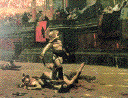
It was Juvenal (a Roman poet active in the late 1st and early 2nd century AD, author of the Satires) that coined this system, a mechanism of influential power over the Roman masses. "Panem et Circensus", literally "bread and circuses", was the formula for the well-being of the population, and thus a political strategy. (We're well learning all about societal and political strategies today aren't we!)
The Roman formula offered a variety of pleasures such as: the distribution of food, public baths, gladiators, exotic animals, chariot races, sports competition, and theater representation. It was an efficient instrument in the hands of the Emperors to keep the population peaceful, and at the same time giving them the opportunity to voice themselves in these places of performance.
Before the construction of the relative buildings that functioned as the city's central administration, the Forum area was the theater for gladiator combat. These gatherings began at the rise of 122 B.C. Reserved stands for respected spectators were constructed around the piazza (square) of the Roman Forum, excluding the poor classes. Successively, Caio Gracco had these exclusive stands destroyed, winning the favor of the common citizens.
The organization of games was an occasion to climb up the ladder of political popularity: this mechanism degenerated in performances so magnificent that they became "folly", described as such by Lavio.
During his youth, Caesar was famous for the magnificent games he organized, as he had hundreds of gladiators fighting each other. His political opponents were worried about the ambitions of this new rival, but he still established a reputation as a generous friend to the public. Caesar organized these games by borrowing a lot of money that was in turn well invested into propaganda earning him important positions in office. Consequently, these positions enabled him to pay back every cent that he had borrowed.
Besides using them as a political strategy, Caesar had a true passion for the games. The people were grateful to him and showered him with honor and positions in large quantities. Caesar is still celebrated as one of the prominent personages of Romanity: it was Caesar that began the Roman Empire.
With time the public became more demanding and began organizing performances that were even more costly and magnificent: Octavian Augustus, Caesar's adopted son and prince of Rome, organized "extraordinary" games where 10,000 men battled against 3,500 wild animals from Africa. Also, in 107 A.D., Trajan, on occasion of the victory against the Dacians, organized battles of over 10,000 gladiators that lasted 123 festival days and in which 11,000 wild animals were killed. This record was never to be exceeded, since Trajan walked away from these battles with a sum of 10,000,000 kilos of gold, 20 million kilos of silver, and 500,000 slaves.
The provinces of the empire also had their games that took place in the amphitheaters constructed by the Romans, including: France, Spain, Britain, and all of Italy. The nobility of every city acquired prestige organizing these games and the Roman Empire earned popularity. Of course, only about ten gladiators fought, which was nothing compared to the splendor seen in the city of Rome.
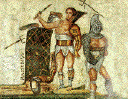
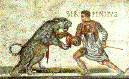
The majority of gladiators were prisoners of war and slaves that were obligated to fight in order to survive. Also, sentenced criminals were brought to the arena to be almost certainly killed by sword -"ad gladium", or by ferocious wild animals- "ad bestias". Rather, the autocrats, who had free choice to fight, scorned danger and were only interested in becoming rich with prizes. Some of them were true popular heroes.
The gladiators were German, Spanish, Welsh, Britannic, black Africans, nomadic Russians, and Jews from Jerusalem. This also had political significance: using the defeated enemy to entertain the public was a triumph in victory.
The wild animals consisted of elephants, tigers, lions, hippopotamuses, gazelles, panthers, camels, wild boars, bulls, deer, leopards, and elks. Only a few of these animals were saved by being sent off to the emperor's zoo, while the rest were cruelly killed.
The games were often too violent and abusive, like the time when Caligula (37-41 A.D.) sent innocent people from the public to battle because the gladiators were being killed off too fast: the unfortunate had their tongues cut off so they could not yell for help.
The Coliseum, or Flavian amphitheater, was constructed in 70 A.D. in ten years; it was the largest and most magnificent monument dedicated to the games with 50 meters on 4 floors, a diameter of 188 meters, constructed with 100,000 cubic meters of travertine marble and 300 tons of iron, and a capacity with over 50,000 places to sit.
The Circus Maximus was the most grandiose building for public performances ever constructed. Adorned with statues and decorated with noble metals, this place was used for chariot races. 650 meters long by 125 meters wide, it initially had 150,000 places to sit. After the reconstruction that Trajan wanted between 100-104 A.D., available seats expanded to 350,000. Many businesses and stores were located in the Circus Maximus. The races that took place had precise rules that resulted in violence, much appreciated by the public.
But there weren't only violent and cruel performances. The theater was one of the preferred places of the Romans, especially for those looking for a companion. Such was written in 2 B.C. by Ovid in the "Art of Love", an audacious and somewhat obscene book about the tricks for finding a fiance or fleeing from a jealous husband.
In the II century B.C. mimes performed and later were the first playwrights, tragedies, pantomimes, and "canzonettes" (songs).
Therefore, much like our society today, the phenomena of stardom, critics, and scandals, want it or not, becomes a part of our lives.
One of the great parts about blogging is that it is free-flowing... you can keep adding and adapting commentary over time... so check back again for any changes to this post or others to be added.
And some ask... why Cuba? Well, even if it were not for the previous links from the past (two stops while in the Navy at GITMO, and my father's visits to the country when he was a young man... the largest island of the Antilles would still hold a major fascination and be a constant draw. It was a half-century ago that Cuba was the 'Jewel of the Caribbean'.. and still would be if not for cruel fate. It's prominent location smack between the US and South America, and it's resources would have made it a major player in the region. But all that was not meant to be, and now it's future is again in question.. no one knows what direction it will soon be heading.
CUBA Trip - April/May 2012
Time in Cuba stopped 60 years ago, right at the moments after the revolution.. now everyone is still living with the difficult consequences.. and many are struggling just to get by!!
When you consider this wonderful mind-altering country is only a short 40 minute plane ride away from southern Florida.. (you're over the Keys in a few minutes)... it is unbelievably bizarre!!
Infrastructure
So much needs to be done... most everything is corroding and visibly falling apart.
There's lots that is extreme.. the road system's beyond terrible... especially the eastern portion of the country. Everyone uses the roads together.. trucks, buses, cars, people, bicycles, horse and oxen drawn carts... everyone.. all jockeying for position. Unbelievably, in some locations they even use roads for spreading out and drying their rice crops!!
Most areas you can travel for hours having to avoid bumps and potholes the whole time. Roads across the entire country need to be resurfaced and for sure widened (they're exceptionally narrow). And it would surely be a massive undertaking to redo the road crossing the eastern mountains over to Baracoa.. but it really is totally necessary.
Living Conditions
In one word... dire. Go into what was once a remarkable upscale single family building structure that is now housing two dozen or more families... or out in the countryside view the blocks and blocks of the old soviet-style housing complexes, and you can imagine and dread their living conditions inside.
There's such a small band that most all the population live within... not many existing outside above or below. There's not much visible abject poverty, and not large numbers of those very well off. Even within the most well-to-do neighborhoods many signs of decay are present.
In most every hotel outside the main cities there is no immediate hot water.. it has to be 'turned-on'... and soap and toilet paper is at a premium (hair shampoo mostly non-existent).
The one main positive it the fact that there is absolutely no commercial advertising ANYWHERE... no billboards, no advertisements, no signs.. nothing. The only country in the world so far that we have not seen any commercial advertising.
The People
The Cuban people are most deserved of admiration and credit... other populations having to endure 60 years of harsh one-man rule, coming immediately after another of additional torment, they are truly to be marveled. For they are a vibrant, sincere, and most warm & charming people.
We have much to admire and learn from how they exist together.. it's not perfect, but the way we are trending in our country needs to be reexamined, and looking at they way in which Cubans coexist under what are very demanding conditions provides some much needed perspective.
The Food
Cuban food is among the most vibrant, interesting, flavorful cuisines to be found in the Caribbean. Combining elements of traditional Spain with foods indigenous to the region, Cuban food provides a powerful link to island memories and traditions.
And we did have several exceptionally good meals on the trip (La Guarida was a wonderful restaurant.. should ya ever get to Havana, a must visit)... but on the whole for the entire 12 day journey, it was mostly bland and very boring... the same basic salad of tomato, cucumber, shredded cabbage, and the running joke of canned green beans (awful)... then rice with black beans, and beef, chicken, or pork.. and the occasional nondescript overcooked fish.
These meals were what 'they' thought American tourists would prefer to eat... most of the group increasingly complained, but little got changed. The food at those restaurants that were privately run was the much better product, and prices were exceptionally reasonable at these private restaurants when considering the obvious differences to those state run.
The Culture
Cuban culture enjoys a rich heritage in the field of art, music, literature, and dance. Music in Cuba is influenced by the musical styles of Spain, France, US and Americas.
Music and dancing are a main source of entertainment for most all Cubans, and many important dancing forms such as Salsa have their roots in Cuba.
... and you can take the tour lecturer-historian (Frank) out of Cuba.... but when he returns.... watch out!!... ;~)
Frank's presence and invaluable work on the tour was of huge benefit to all participants. It would not at all have been the same experience without him. We're really looking forward to reading his book - Batista.
Religion holds an important place in the life of Cubans with main religions being Catholic and Santeria. There is a large arts presence in the country, especially in the major cities.. small private galleries are down many side streets. Music and dance are most everywhere to be found. Baseball is huge.. and cockfighting is prevalent (videos below).
The only newspapers Cubans see are Granma and Juventud Rebelde (Rebel Youth), two staid mouthpieces of the Castro regime.
Internet access is practically nonexistent for the majority of the people. And when there is limited access, going online in Cuba will try the patience of anyone who's ever had a taste of high-speed connections. And according to the government 1 in 6 Cubans were online in 2011, mostly through work or school, and often just to the intranet... at 3-5kb per-second dial-up transfer speeds. The National Statistics Office said last year just slightly less than 3 % reported having direct internet access, though outside experts estimate the real figure is likely 5-10 % accounting for black market sales of dial-up minutes. For a variety of reasons including the 50-year-old U.S. economic embargo, Cuba is the last country in the Western Hemisphere to get a fiber-optic connection to the outside world, and has relied instead on costly and slow satellite linkups.
Satellite television is an unimagined luxury very few can afford... as are cellphones.
On many issues in the country, there is a substantial generational divide in Cuba.. younger Cubans want immediate change. and older generations the status quo, and are uncertain and fearful of what might happen when the Castros no longer hold power.
Economy
Bottom line.. a basket-case. With a majority of the population (80%+) being government employees making the equivalent of $20 dollars a month... everyone is out to try and make additional income. And then most all of this form of 'commerce' is illegal by government definition (but of course they know it exists). Everyone is out to try and 'work the system'.. not to get rich by any means, but just to survive. The GDP of the entire country of 11.5 million is maybe $60-70 billion dollars... and no one is quite sure just how this compares to the size of the 'shadow' economy existing alongside it (which is rapidly growing).
As for agriculture, this is a very large island, with a very large amount of arable land, yet they import a majority of the food stuffs they require, and a third of their beef consumption is imported.
And they would not be able to afford oil they require without substantial subsides from Venezuela.
Government
When governments have an autocratic rule that supersedes the will and well being of their people, it's an absolute recipe for disaster... (be it forms of socialism or crony capitalism). Any state that controls most all businesses is not going to operate a majority of them any where near effectively, and Cuba is no exception. Go to any of the state run restaurants or state operated hotels, then visit their privately run counterparts .. the differences are obvious and numerous, no matter what anyone might be saying to the contrary. As things move forward within a generation big changes could be coming.. no one attempts to say what will happen. And it goes without saying, little will happen until the 'powers' (mainly that reside in southern Florida & in Havana) allow things to change.. another generation or so needs to go by.. burying ghosts... lessening the wounds.
Tourism
Americans are increasingly traveling to Cuba.. but to do it legally you still must go with a group that has a license to visit. This dramatically increases the cost, and restricts who has the means to travel to the country. You can enter on your own from Canada or Mexico but that adds additional travel and expense.
And as it is right now, you are an American you have got to be ready for a 'travel adventure'... not a vacation. The rest of the world might get to relax on the sun drenched shores at the better run resorts.. but Americans are still forbidden to go to any of these locations.
We are not allowed to be 'tourists'... just cultural exchange participants, that are allowed to stray little from the tightly run tour-group itinerary. The exception are those Americans with family ties in Cuba, they are now allowed to pretty much go back and forth freely and do as they will while in the country... bringing with them to Cuba as much as they can reasonably carry (as the chaos at Miami airport reflected when we were going over).
The Military
There is not a large visible 'military' presence across the country, but you get the feeling that it would not be long for one to appear when needed. As an example, for the Pope's recent visit there were a couple thousand 'precautionary arrests' to stifle the possibility of any activists protests. If you would follow any of the Translating Cuba bloggers you can read about what is really taking place 'on the streets.' And following Yoani Sanchez's tweets, you can learn minute to minute what is transpiring... it is fascinating stuff. (Not being able to meet with her as originally talked about prior to our visit was another major disappointment of the trip.)
There is though a good amount of a visible police presence in most all areas of the country, so call them what you will, they are uniformed, well armed, and in all likelihood would ultimately respond completely to the central command running the country (or else).
...cities visited on our 12-day tour of Cuba...
Cities Visited: Baracoa
Flew into Holguin early one morning from Miami and took the bus to Baracoa. A very remote location all the way on the eastern portion of the island... cut off by a mountain range to the west. It was a very long drive on one of the most continually bad roads we have ever had the misfortune to traverse.
One of our stops here was to have been a maternity home, but it was cancelled (we were told the government would not allow it). It's a distant part of the country where horses and oxen prevail. Had it not been the location where Columbus first landed, we would in all probability not have visited there.
Santiago
The was no Guantanamo Bay stop as had been indicated in the pre-trip material (a major disappointment). In effect we did nothing but a 'drive-by' from 20 miles away (security reasons was the only explanation given).
The hotel we stayed at in Santiago had no working elevator, the material indicated it was being 'fixed'..when in fact the entire elevator 'system' was in the middle of being completely replaced and would probably have been out for weeks already, and several more to come (the way things function in the country).
Several stops in Santiago were for the most part pleasant, but nothing of particular note.
Camaguay
The historical museum detailed in the itinerary we were to have stopped at was not open. And a stop at a violin workshop had to be postponed till another day.
The hotel was decent.. again no working elevator.. same reason - being replaced. The state must have gotten one massive country wide contract to replace all the outdated elevators across-the-land, for we saw this again and again.. everywhere.
Did unexpectedly go out and get to view several state sanctioned cock-fights...
... (after a 20 minute ride outside the city in a '74 Peugeot, with no windshield)...
... and a full 9 inning playoff series baseball game...
..(absolutely marvelous fan support & sportsmanship.. nothing like the absurd spectacle we now have)..
Sancti Spirtius
Originally the tour had been scheduled to stay in a location just slightly outside of Trinidad along the coast... this was altered last minute to a hotel location in the inland city of Sancti Spirtius, which then necessitated bus ride of 3 hours (total -back and forth) to visit Trinidad.
Both cities were again pleasant stays, but would say without too much hesitation, none on the tour would list either of them as a return 'bucket-list' selection.
Trinidad is pretty much a given 2-day tour stop, as part of a 7-day Cuba tour (Havana, being the other 5 days).
Havana
Largest city in Cuba and its' capital with over 2 million inhabitants.. all in what are basically low-rise very deteriorating structures. It once was for sure the jewel of the Caribbean, attempting to emulate the old world cities of Europe in its' opulence... some of which can still be seen to this day. What an absolute crime it could not have been left to continue on.
It's a gritty, vibrant city... but what will remain in the minds of most, it just how much deterioration it has suffered. Had expected to witness some decay, but major thoroughfares show exactly just how limited are resources in this country to restore the city to its' former grandeur... there is NO money!
And what are purported to be five star hotels, by anyone's standards would be three at best in other parts of the world.. and their pricing is a good proportion higher than it should be considering the quality.
And no discussion of Cuba would be complete without talking about...
The Cars ....
Most all from years prior to the revolution. They just keep getting older and more beat up in most cases (few are gorgeous)... but they keep 'em rollin. These folks have a real talent for swapping parts (and/ or inventing solutions) to put off seemingly forever their demise.
It's a true force of will.. a nation of antique car mechanics.
Might be tempted to again visit the country should things 'open-up' to unrestricted American tourism. But not before several years go by, and that which is much needed to get accomplished...gets done.
We'll just have to wait and see.
Just recently came across this video of old Havana... it really makes you wonder where they would have been today under different circumstances...
PS... To post pix from the trip shortly... been so far working to clear the backlog of reading built up from being away for the couple weeks.
World Affairs Council travel programs offer all the highlights of touring plus access to political leaders and other local experts that give behind-the-scenes views and briefings making trips special and unique. With established connections around the globe allowing them to offer members access they can't get when traveling alone or on other tours.
Trip Leaders: Dr. Frank Argote-Freyre Kean University - News Transcript (Comm. on New Americans) - Rate My Professors An assistant professor of Latin American history at Kean University, Dr. Frank Argote-Freyre received his Ph.D from Rutgers University in 2004. His first book, Fulgencio Batista: From Revolutionary to Strongman was published in 2006. His second book, A Brief History of the Caribbean, coauthored with Danilo Figueredo, came out in January 2008. He is currently working on the second volume of his Batista biography. Prior to embarking on scholarly pursuits, he worked as a journalist for 10 years and as a congressional press secretary. Dr. Argote-Freyre participated in a World Affairs Council of Philadelphia Great Decisions program on Cuba.
Shoshana Altrichter - Associate Director of Travel - WAC (saltrichter@wacphila.org) With the travel department at the World Affairs Council for over seven years, Shoshana earned a B.A. from Drexel University in Philadelphia. She has led several Council tours including a Ukraine Dnieper River and Black Sea Cruise, a Russia River Cruise, and a cruise to the U.A.E. and a tour to Iran with Ambassador Mark Johnson, a tour to Israel, and a Mekong River Cruise.
Distant Horizons tour escort will be Julie Gilders.
Julie is
fluent in Spanish and she knows Cuba well. She has worked as a
tour manager all around the world. Julie is from the UK and most
recently has led a UK group in Cuba. Julie will meet you at the
arrivals area after you have collected your luggage in Holguin.
Links to articles and information regarding recent Cuba stories:
Fidel Castro's jab at Obama - (Fox News Latino) for planning to wear designer guayaberas to a meeting of the Organization of American States while still resisting Cuba's participation at the meeting
Will the Real Terrorist Please Stand UpThis documentary chronicles half a century of hostile U.S.-Cuba relations. The film highlights decades of assassinations and sabotage at first backed by Washington, then ignored by the very government that launched a "war against terrorism."
Please download these two files and save to your computer to follow along during our conference call with Dr. Frank Argote-Freyre on Wednesday, April 18 at 2 p.m.(EST) The toll free number to call in is 1-877-914-0563 and the pass code is 2904903. As you join, please announce yourself.
************
"The
greatest reward and luxury of travel is to be able to experience
everyday things as if for the first time... to be in a position in which
almost nothing is so familiar it is taken for granted."
OK.. been looking for a Black Sea cruise since we came off the last sea voyage in Istanbul last year. So... we went on-line and made a tentative commitment (cabin 8063) for this cruise next year.
Azamara Club Cruises is a new cruise line for us... we'll see how it goes... their parent company is Oceania. They're identical in style to Regent, another Oceania line, with which we are very familiar.
...click-on for details and to book (from August 18th, 2013 to August 30th, 2013)
Voyage Summary
A terrific opportunity to explore the Black Sea in some depth, with stops along Turkey’s Northern Coast, Georgia, and Russia. It also includes Ukraine and Romania, with optional overland trips to history-rich Kiev and Bucharest. Along your voyage route, join optional Land Discoveries to Safranbolu, a well-preserved Ottoman Empire town, and to the cliff-hanging Sümela Monastry and Kackar Mountains. You’ll also visit the charming resort town of Batumi, and Sochi, the site of the 2014 Winter Olympics.
There is only one 'at sea' day, and of all the ports to be visited, only Istanbul is one we have previously visited... for us, this is exactly our kind of cruise itinerary... many new & interesting destinations, with minimal at sea time!!
Cruise Itinerary
DATE PORT/ CITY ACTIVITY- ARRIVAL - DEPARTURE
Sunday, August 18 Istanbul - Turkey Embark 5:00 PM
Azamara - 'Journey' (different cruise... but the video gives an idea of life onboard Journey)
Azamara Club Cruises fleet (Journey & Quest are sister ships) is a new cruising option available to passengers who prefer the boutique-hotel atmosphere of a smaller ship without the luxury-class price tag.
Seven classes of staterooms are offered onboard Journey. The exclusive experience includes butler service in suites and concierge-style amenities in all categories of accommodations. (Want to book a shore excursion or get a reservation in the special restaurants? Just tell the butler what you want, no forms to fill in or lines to wait in. Want a full dinner from the dining room menu served course by course in your stateroom? The butler will do it.)
All suite guests receive complimentary chilled soda, bottled water and two bottles of hard liquor at no extra cost. A chilled bottle of champagne is set in the room before embarkation. Complimentary wine is available by room service at any time.
A self-service launderette (with flat-screen television and upholstered armchairs) is available.
One pool sits on the center of the ship, surrounded by a designated jogging track on the deck directly above.
Two specialty restaurants, a main dining room, and a handful of light food and casual dining areas offer a variety of dining options..to include a casual sidewalk cafe-style coffee bar. (The dress code is always resort casual with no scheduled formal nights. No bare feet, tank tops, caps, bathing suits, or jeans are allowed in the dining room or specialty restaurants.)
Wine is complimentary lunch & dinner, coming from a collection of 'boutique' wines from South Africa, Australia, New Zealand, Spain, Portugal. On the rare occasion, should the wine selected not be to the liking of the customer, other complimentary wines are offered. There is also an extensive list of 'special wines' available for an additional fee.
Seven lounges, a fitness center and distinctive Astral Spa, with an acupuncture suite and expansive relaxation deck with therapy pool.
Aside from the several lounges that double as nightclubs, there is Casino Luxe, with signature 'Martini Bar.'
Deck 11
Sun Deck
Deck 10
Aqualina Restaurant
If you're in the mood for fantastic Mediterranean-inspired cuisine, make a reservation at Aqualina, one of our onboard specialty restaurants. Aqualina will satisfy your taste for sumptuous fare in a relaxed, yet positively chic atmosphere.
Prime C Restaurant
If steak and seafood are on your mind, then make your way over to Prime C. Full of atmosphere and loaded with flavor, this specialty restaurant surely aims to please all who enter. The broad wooden floors and rich paneling are more than inviting and the steaks will melt in your mouth.
Michael's Club
Soak up the sounds of a grand piano as you share an intimate nightcap in this locale. The ambiance is inspiring and the deep, welcoming chairs of Michael's Club make it the ideal place to savor a single-malt scotch or a late-evening cordial.
Looking Glass
Oh the glorious views from the Looking Glass. Of all the locales to relax and unwind aboard, this might very well become your preferred spot. Enjoy your favorite cocktail, admire the Murano glass, and gaze out the floor-to-ceiling windows and revel in how good life is at the moment. There's even a telescope so you can see what's waiting on the horizon.
Deck 9
Astral Spa
How will you choose to relax today? Melt your cares away with a 90-minute massage; invigorate yourself with a lime and ginger scrub or indulge in a silky, milk bath. Let our Spa transport you to a whole new world with treatments inspired by rituals from exotic cultures. You'll also find a hair salon, a Thallosotherapy pool, and an assortment of the finest spa products.
Fitness Center
Keep up your fitness routine or embark on a new one with our onboard Fitness and Wellness Center. Take part in yoga at sunset or toning Pilates; our onboard Wellness consultant is there to assist you every step. You'll also find quality apparel and more.
e-Connections
We know that you will want to share your cruise experience with friends and family - even before you return home. eConnections is where you'll find onboard Internet stations to stay in touch.
Windows Café / Breeza
Akin to dining in the comfort of a friend's home, our buffet restaurant is casually elegant with a welcoming atmosphere and spectacular views. Choose to dine inside or out and feast on a lavish display of culinary genius for breakfast, lunch or dinner. While there, be sure to admire the creations of our sugar and chocolate artists; the experience is sure to impress.
Deck 8
Bridge Deck
N1 N2 Suites
Club Continent Suite - (Cabin 8063)
The bedroom of a Club Continent Suite resembles a regular hotel room rather than a stateroom on a cruise ship, with more space to move about the bed and living areas. The cabin bathroom is fairly spacious and well lit and comes with a full-sized tub and marble counters. The balcony veranda is rather large for a two person stateroom. There is room for a table to fit lengthwise, as well as a few chairs.
Features:
326 sq ft cabin (266 SF Stateroom - 60 SF Veranda)
• Two lower beds convertible to queen size
• Floor-to-ceiling sliding glass doors
• Veranda
• Sitting area with sofa bed
• Bath tub
• Flat screen-television
• CD/DVD player
• Refrigerator with mini-bar
• Thermostat-controlled air conditioner
• Direct-dial telephone and voicemail
• Desk
• In-room safe
• Hand-held hair dryer
Decks 6 & 7
All Suites (and Lifeboats)
Deck 5
Cabaret Lounge/ Theater
Our showcase theater features a talented cast of singers performing some of the hottest shows at sea. Best of all, every seat in the house is excellent and you'll love the long, comfortable bar and excellent service.
Casino Luxe
Whether you're feeling lucky or you just enjoy the adrenaline rush of a casino, step into ours and you won't be disappointed. You'll find all your favorite table games, video slots, and a centrally located bar.
Photo Shop
Come take a peek at the fun and professional photos captured by our onboard photographers. You can also find an assortment of supplies for your own photographic endeavors.
Indulgences
Aptly named, Indulgences will satisfy your desires for the finer things in life. From designer eyewear to sought-after cognac and everything in between, it's the perfect place to window shop or to find that extra special purchase.
The Journey Shop
It's one-stop shopping at The Journey Shop. Apparel, sundries, handbags, candies, cigarettes, souvenirs and lots more await. If you find that you forgot to pack something, chances are you'll find it at The Journey Shop.
Mosaic Café
Our onboard coffee corner may very well become your favorite nook on the ship. You'll find all your favorite coffee drinks and you can order them just the way you like them. We recommend that you slip right into a comfortable seat and sip for a while - you never know who'll walk by.
Discoveries
With open seating and stellar nightly selections, our main dining room, Discoveries, is not to be missed. You'll find all your classic dinner favorites, with a deliciously different twist, like gulf shrimp with cognac and garlic or a filet mignon with black truffle sauce. What's more, open seating provides you the opportunity to dine at your leisure.
Looking forward to this trip... have wanted to go to Cuba for a very long time.
My father, when he came from Spain as a young man, visited the country several times before things were shut down. He always spoke about how much he enjoyed visiting, and how he looked forward to going back. As was the case with his returning to Spain someday... he never did.
Now we get the opportunity... and are in the early discovery/ planning stages for the impending visit.
Comprehensive, 12-night journey. Meet-the-people and understand Cuban views on the matters that mean most to them. This is not a tourist program but rather an opportunity to engage with Cubans from across the social spectrum and enjoy a meaningful exchange of ideas. Beginning in the eastern part of the country we will learn about Cuban history, culture and society from the local people we meet. Fly into Holguin and drive to Baracoa, site of the first Spanish settlement. Then in Santiago, engage with Cubans involved with the city’s lively dance and art scene. Stop in Camaguey and Trinidad. Visit a school, hospital and cooperative. Finally reach Havana – the political capital – and a center of biotechnology, eco-movements and a cornucopia of the Arts.
Curious about Cuba? Then join Council members on this comprehensive, 12- night journey through this intriguing Caribbean island. Meet-the-people and understand Cuban views on the matters that mean most to them. This is not a tourist program but rather an opportunity to engage with Cubans from across the social spectrum and enjoy a meaningful exchange of ideas. Beginning in the less visited eastern part of the country we will learn about Cuban history, culture and society from the local people we meet. Fly into Holguin and drive to Baracoa, site of the first Spanish settlement. Then in Santiago, home to Cuba’s oldest palaces and museums, engage with Cubans involved with the city’s lively dance and art scene. Stop in Camaguey, a lovely colonial town with unusual museums, and Trinidad, perhaps the best-preserved Spanish colonial town. Visit a school, hospital and cooperative. Finally reach Havana – the political capital – and a center of biotechnology, eco-movements and a cornucopia of the Arts.
Dr. Frank Argote-Freyre is an assistant professor of Latin American history at Kean University. He
received his Ph.D from Rutgers University in 2004. His first book, Fulgencio Batista: From Revolutionary
to Strongman was published in 2006. His second book, A Brief History of the Caribbean, co-authored
with Danilo Figueredo, came out in January 2008. He is currently working on the second volume of his
Batista biography. Prior to embarking on scholarly pursuits, he worked as a journalist for 10 years and as
a congressional press secretary.
Dr. Argote-Freyre participated in a World Affairs Council of Philadelphia Great Decisions program on
Cuba. He is leading our March Cuba tour. We are pleased to share his expertise with our members.
Please note however that he will miss the last two days of the program as he must return to the U.S.
1- April 24. Tuesday: Holguin/ Baracoa.
Fly on a direct morning flight from Miami to Holguin using ABC charters. (Depending upon timing,
members may have to stay overnight April 23 in Miami at their own expense.)
Enjoy lunch at the Restaurant 1720- a beautifully restored mansion.
There will be a chance to explore this city – Cuba’s 4th largest which is known as the “city of parks”.
Walk through the Parque Colon Garcia and stop at the Natural History Museum which has the world’s
smallest frog as well as the world’s smallest hummingbird. Meet with curators and staff.
Depart along small provincial roads for a 4 hour drive to Baracoa.
Upon arrival in Baracoa transfer to the Hotel Porto Santo.. Trip Advisor Reviews ... (changed, not HotelCastillo). Baracoa is an attractive town surrounded by rich, tropical vegetation. The name Baracoa is an Indian word meaning ‘existence of the sea’. Christopher Columbus arrived in Baracoa on November 27, 1492. He planted a
cross, now housed in the church, and described a mountain in the shape of an anvil which was thereafter
used as a point of reference for sailors. Baracoa is full of references to Columbus’ stay here. Porto Santo
marks the place where he was married in 1514, the same year that the capital of Cuba was moved from
Baracoa to Santiago de Cuba by Diego Velazquez. Baracoa was the first of the seven cities founded by
Diego Velasquez, and as such, is considered to be the oldest colonial city in the Americas. Between 1639
and 1742, Baracoa’s three forts – El Castillo, Fuerte de la Punta and Fuerte Matachin – were built by the
Spanish to protect the city from invasion. After the revolution in Haiti, Baracoa became a refuge for
French exiles and they brought with them coffee and cacao farming techniques as well as their own style
of architecture.
This evening meet with Dr. Alejandro Hartmann, the director of the Baracoa Museum and the city historian. Enjoy a lecture called “Local History and Legends of Baracoa”. B,L,D.
2- April 25. Wednesday. Baracoa.
Morning sightseeing in Baracoa will include a visit to Baracoa’s museum whose displays trace the history
of the region since pre-Columbian days. Continue on to the town’s cathedral which is an ocher-colored
edifice dating from 1805 and was built on the site of an earlier church which was destroyed by pirates in
1652. The cathedral contains the cross known as the “Cruz de la Parra” which is said to have been
brought here by Columbus. Although historians have now confirmed that the cross dates back from his
time period, it now seems unlikely that Columbus actually brought the cross from Europe.
Explore the charming Plaza Marti which is surrounded by colonial houses and features a small tobacco factory located inside a small blue house. Inside rows of men and women sit side by side, tenderly rolling and pressing
cigars for local consumption. A blackboard shows production goals and achievements.
This is a wonderful opportunity to learn how cigars are made. First, the filler is rolled and placed in a press so it
keeps its form. Then the wrapper is trimmed to one side straight and the other curved and rolled around
the filler. All-natural vegetable glue and water hold it in place. After trimming the loose pieces of leaf, the
cigar is ready to smoke. The process does not end here. The cigars then go to quality control where a
percentage are measured for size and opened to check the blend. Next they are sorted by color and packed in a scale with the darkest on the left and the lightest on the right. Finally, labels are wrapped around the cigars that are then packed in boxes and sealed with the necessary symbols to indicate their authenticity as real Havana cigars. On average, a roller makes about 90 cigars a day, depending on adeptness and the shape of the cigar – there are over 60 shapes and some are more difficult than others. We will be able to stop and talk with the workers as we see the skills they employ in the process.
Drive a few miles outside of town to the Duaba River where a short boat ride has been arranged. Cruise
through lush landscapes and forests where the air is filled with the chirps and squawks of more than a
hundred different bird species. Enjoy a delicious lunch at the Finca Duaba beneath the shade of palms and plantains. The final stop for the day will be at the village of Guirito where local famers will perform
adaptations of Cuban song – dance – known as el nengen and el kiriba. Afterwards opportunity to chat with
the farmers.
This evening after dinner attend a magnificent performance of Afro-Cuban dancers in the local Casa de la
Cultural. Dr. Hartmann will accompany the group and provide background on this quite extraordinary
performance. After their performance, meet the dancers depending on their schedule. B,L,D.
3- April 26: Thursday: Santiago
Enjoy a spectacular drive from Baracoa to Santiago. Stop in Guantanamo to pick up an escort who will
accompany the group to the east side of Guantanamo Bay which overlooks the Guantanamo US Naval Base, one of the oldest US overseas military bases. (I visited GITMO a couple times during a tour of duty while stationed onboard the aircraft carrier USS John F. Kennedy CV-67... now decommissioned.) It is the only one located in a communist country and is a constant thorn in the side of Cuban-US relations. Since 1903 the US has held an indefinite lease on the property which it claimed as a prize at the end of the Cuban-Spanish American War. The rent is $4,085 a year. Since 1959 the US Treasury checks have not been cashed by Fidel Castro. Enjoy a cool
drink at a cafe called Mirador de Malones. From here it is possible to use binoculars to look right down
on the US base. It is not possible to visit the base itself. The base produces its own water (through a
desalination plant) and has 400 miles of paved road.
Upon arrival in Santiago transfer to the recently renovated Hotel Casa Granda, Trip Advisor Reviews ... splendidly situated on Parque Cespedes and the place where Wormold stayed in Graham Greene’s Our Man in Havana.
After lunch at a local restaurant, enjoy an orientation tour of the area north of the hotel including the
Moncada Barracks which is known for being the place where, on 26 July, 1953, Fidel Castro and 79
soldiers dressed in Cuban Army uniforms, stormed the barracks. Although no longer used as barracks, the
building houses a superb museum that tells the tale of the attack, the revolution and subsequent history.
Meet with staff of the museum. Drive by the Plaza de la Revolucion which is dominated by a massive
monument to Antonio Maceo, the hero-general of the War of Independence.
Return to the hotel for drinks on the roof and dinner. For those who would like to, enjoy an after-dinner
stroll around the Parque Cespedes, which is ringed with gas lamps, metal grills and tall shade trees. The
beautiful white colonial building on the north side is the town hall. It was from here that Fidel Castro
gave the victory speech on January 2, 1959, after he entered town following Batista’s flight from Cuba.
B,L,D.
4- April 27. Friday. Santiago.
Take a full day to explore the second largest city and former capital whose population has the highest
percentage of African blood. Though the traditional architecture is mostly Spanish, the faces are dark –
often with light eyes betraying hints of European blood. For many years the city of Santiago and the
surrounding region was a clearinghouse for many different nationalities. Its east-facing position and
proximity to Jamaica and Haiti fostered close links between the city and these two Caribbean islands. In
addition, many of the French planters and merchants who fled Haiti following the revolution in 1791
chose to settle in and around Santiago. The rich racial mixture has produced some of the most exciting
music, art and architecture in the Caribbean. This port city is also an industrial city and the distilleries of
the original Bacardi rum are here.
Begin the day at the Museo de Arte Colonial which is said to be the oldest house in Cuba. It was built in
1516 as the home of Cuba’s conqueror, Diego Velasquez. Along the second story runs a balcony built
with a Moorish-style wooden grille to shield its delicate aristocratic occupants from prying eyes. Continue
on to the Jesuit Dolores College where Fidel Castro was educated as a youth. It was one of the most
profound intellectual influences in his life. Meet with professors and students.
Stop at the Tomás Romay Natural History Museum and the small but impressive Botanic Garden
dedicated to ferns, many of which are endemic to Cuba. Learn about the museum from docents.
Drive south of the city to a restaurant called El Morro set atop the cliffs with fabulous views along the
coast. After lunch visit the Morro Castle itself, which was originally built in 1640 to ward off pirate
attacks. Unfortunately, this effort failed and in 1662 the pirate Henry Morgan stormed it and then blew it
up. A more solid structure was begun in the late 18th century and this is what one sees today. From the
battlements of the Castle there is a spectacular view of the harbor and its bottleneck entrance. The interior of the castle houses the Museo de la Pirateria, an exhibition of pirates during the colonial and modern eras.
In the afternoon drive to the Basilica del Cobre which takes its name from the large copper mine that the
Spanish established in the mid-1500’s. The church – Cuba’s only basilica – is known for its offerings and
as the shrine to La Virgen de la Caridad (Virgin of Charity), patron saint of Cuba, to whom miraculous
powers are ascribed. In 1952, Hemingway dedicated his Nobel Prize for Literature to the Virgin although
the medal is now in the custody of the Archbishop of Santiago.
The final stop for the day will be at the Caney Rum Factory which was built in 1868 by the Bacardi
family and nationalized in 1959. The Cuban government continued to make rum under the Bacardi name
but Bacardi sued and won the lawsuit. Ever since, the rum produced from this factory has been sold as
“Havana Club”. While it is not possible to tour the factory, it is possible to sample some of the rums as
we chat with hosts at “Havana Club”. B,L,D.
5- April 28: Saturday. Camaguey. Morning drive to Camaguey stopping en route at the city Las Tunas, capital of the province of Las Tunas
which lies 662 km east of Havana. The city, originally named Las Tunas was, in 1869, renamed Victoria
de Las Tunas, a title given it by its Spanish governor to commemorate a colonial victory over the
Cubans. The name reverted to plain Las Tunas in 1895, following the battle in which the Cubans finally
took back the city. These days Las Tunas is a center for trade in the production of sugar and chemicals.
Tour the Provincial Vicente García Historical Museum which rises majestically in the heart of Las Tunas
City. In the opinion of architects, the building is a true expression of eclecticism. Others consider it a
principal reference to local geography. Undoubtedly, it is an incomparable symbol of history and identity.
Its construction dates back to the days when Don Rafael Zayas González, a local illustrious journalist,
was the town’s major. So as to accomplish a work filled with distinction and elegance, the renowned
Santiago de Cuba-born professional Carlos Sagarra Fernández, was hired as principal engineer. The
building was officially opened in 1921. Invaluable historical pieces are stored in its eight exhibition
rooms, through which thousands of Cuban and foreign visitors have passed.
After lunch continue on to Camaguey and overnight at the Gran Hotel de Camaguey ... Trip Advisor Reviews ... (not Colon Hotel).
We have requested a special visit this afternoon to Minas to visit a violin workshop which opened in
1976. The workshop is run by Alvaro Suarez Ravinal who has over 50 years experience of making
violins. With the Cuban Ministry of Culture he is training locals to turn native hardwoods into elegantly
carved violins. He welcomes visitors and participants will talk with some of his trainees. During the 19th
century Camaguey was the center of the rebellion against Spain.
Before dinner enjoy a private Salsa class. Salsa has its origins in Cuba where the blending of African
drum rhythms and Spanish guitar evolved into a variety of Latin American music: Son, Danzón, the
rhythms of Carnival, Cha Cha Cha, Mambo, Salsa and even Tango came out of Cuba. The Salsa
movements originate from the Cuban Son dancing of the 1920s, and more specifically through the beat of
Son Montuno with strong influences from the dance of Danzon, Mambo, Guaguanco and other Afro5
Cuban folkloric dancing. Today's Salsa dancing is a rich blend of Latin-American and Western
influences. Salsa traces a 90-year history in which there are numerous evolutionary paths, sometimes split due to political and social influences. As a result, today there are various distinct styles of Salsa dancing, namely Cuban ("Casino"), New York Style ("Mambo on 2"), Los Angeles Style ("On 1"), Colombian Salsa ("Cali-Style") and Miami-Style Salsa. Salsa is typically a partner dance, although there are recognized solo forms. Salsa can be improvised or performed with a set routine, choreography and freestyle. This will provide a wonderful opportunity to chat with the teachers. B,L,D.
6- April 29: Sunday. Camaguey.
During the 19th century Camaguey was the center of the rebellion against Spain. The most famous native
son is General Ignacio Agramonte renowned for many feats of bravery. Camaguey was also the birthplace
of Carlos Finlay, the doctor who first linked the mosquito with the yellow fever germ.
Today enjoy a walking tour of the large colonial core of the city. It is now a national monument
containing more old buildings than any other city save Havana. Visit a number of buildings including the Casa Natal de Ignacio Agramonte, the birthplace of the patriotic hero and the mansion where his family
lived for many years, it is notable for the third-floor balcony that runs the length of the facade and around
the corner. Now a museum, the house preserves the original furniture and a number of enormous clay
pots. These clay pots were used to store water and historically a family’s wealth could be measured by the number of tinajones (clay pots) in their possession. The pots are now the symbol of the city!
Visit the main theater which is home to the Ballet of Camaguey, the most respected Cuban dance group
after the Ballet Nacional. We expect to look in on a practice class and meet the dancers.
Schedule permitting, attend an Alfareros game. The Alfareros are the baseball team that represent
Camaguey in the Cuban National Series. Formed after the Cuban state redefined its provinces in 1977, the Alfareros advanced the next season to the league championship series, but fell to Henequeneros of
Matzanas. Share the game with local Cuban fans. B,L,D.
7- April 30. Monday: Trinidad. (Sancti Spiritus - 80 km west)
Depart the hotel this morning and drive to Trinidad. En route stop at Ciego de Avila. A small city of
shaded colonnaded shop-fronts, Ciego de Avila is the most modern of Cuba’s provincial capitals, founded
in 1840.
Just before entering Trinidad explore the area known as the Valle de Los Ingenios. This is a living
museum of the sugar industry, featuring 75 ruined sugar mills, summer mansions, barracks, and other
facilities related to the field. The famous Manaca-Iznaga Tower, built in 1816, is 45m high, and the
tolling of its bells once marked the beginning and end of working hours on the sugar plantations.
Ultimately, Trinidad’s prosperity rested on the sugar industry, which was introduced in the 18th century.
As a result of the wealth that the sugar industry brought, Trinidad’s cultural life flourished. Schools of
languages, music and dance were opened and a wide variety of artisans set up businesses, including gold
and silversmiths. Meet some of the artisans.
Continue on to the hotel located just outside of Trinidad on a beautiful stretch of beach. Changed... now the hotel is the Hotel Rijo Plaza in Sancti Spiritus. (Trip Advisor-Review) Enjoy dinner this evening at the hotel ?. B,L,D.
8- May 1. Tuesday: Trinidad.
Spend the day exploring Trinidad, the fourth of the seven cities founded by Diego de Velasquez in 1514
as a base for expeditions into the “New World”. Today it is maintained as a living museum, just as the
Spaniards left it in its period of greatest opulence. It is the crown jewel of Cuba’s colonial cities. The
whole city with its fine palaces, cobbled streets and tiled roofs, is a national monument and, since 1988, a UNESCO World Heritage Site.
Funded by the sugar industry, in 1827 the Teatro Candamo opened its doors. The well-off patricians built
huge mansions for themselves (now museums) and sent their children to European universities. However,
during the second half of the 19th century the Industrial Revolution and increased sugar beet production in
Europe led to the decline of Trinidad’s slavery-based economy. Construction ceased and the city
remained frozen in time.
The maze of cobbled streets is lined with terra-cotta tiled roofed houses in soft pastel colors. Much of the architecture is neo-classical and baroque, with a Moorish flavor reflecting the town’s heritage of conquistadors. The exquisite buildings are fronted by mahogany balustrades, fancy grills of wrought iron, turned wooden rods and massive wooden doors with postigos (small windows) that open to let the breezes flow through cool, tile floored rooms connected by double-swing half-doors.
Begin the day at the Plaza Mayor which is in the center of town and elegantly adorned with glazed
earthenware urns. Around the plaza are the Museo Romantico, the Museo Arqueologia and the cathedral, Iglesia Parroquial de la Santisima Trinidad, which was built between 1817 and 1892. Explore the
cathedral, which is the largest church in Cuba, and is renowned for its acoustics. On the left at the front of
the church is a crucifix of the brown-skinned Christ of Veracruz who is the patron of Trinidad. The altars
are made of precious woods such as cedar, acacia, caoba and grenadine. Continue on to Museo de
Arquitectura which is the former mansion of the Iznaga family. This museum tells the history of
Trinidad’s development. Maps, model structures and sections of houses in miniature, demonstrate city
planning, colonial construction techniques and the fine craftsmanship of the period.
At lunch meet with local entrepreneur David Aloma who recently opened a private restaurant in Trinidad
called Davimart. Mr. Aloma has taken advantage of the relaxed regulations regarding private enterprise in
Cuba and has opened a restaurant with seating capacity for 20 diners. He is employing and paying 3
Cubans who are not family members to assist him in running this restaurant. Meet with his staff.
After a short walk explore the Museo Romantico which houses a collection of romantic-style porcelain,
glass, paintings and ornate furniture belonging to the Conde de Brunet family dating from 1830. Note the
solid carved-cedar ceiling that dates from 1770. The museum is located in a colonial mansion with
breathtaking views over the square from the upper floor balconies. For those who feel like a climb to a
marvelous vista there will be a chance to visit the Antigua Convento de San Francisco de Asis. The tower
and church are all that remain of the original convent.
Return to Trinidad for dinner this evening. Trinidad in the evening is quite different from Trinidad during
the day, and there is something very special about walking down its narrow cobbled streets by the light of
the moon. B,L,D. (Note: We are now staying at a hotel an hour away, so this must have changed as well.)
9- May 2. Wednesday: Havana.
Depart Trinidad this morning and drive to Havana.
Stop at the village of Camilo Cienfuegos to visit the local hospital where the group will meet with
hospital staff. This visit will be coordinated by Joel Yanis, one of the two doctors that staff the hospital.
Continue on to the Pepe Mendez Elementary School. This trip has been coordinated by principal
Mereida Rodriquez and english-teacher Frank Vayadares. There will be a chance to meet with staff
and students and learn more about education in rural Cuba.
The last stop for the morning will be at the local shop where the residents use their “libreta” to collect
their monthly supplies. Our participants will learn about rationing and how goods are distributed to
Cubans. Mr. Vayadares will accompany the group and encourage discussion with Cubans at the store.
Lunch will be at the fabulous Palacio del Valle which originally belonged to Celestino Caceres but was
given as a wedding present to a member of the local Valle family who added to it by producing a
magnificent building.
Continue on to the Bay of Pigs where, in 1962, about 1,300 heavily armed CIA-trained Cuban exiles
came ashore fully equipped to provoke a counterrevolution to topple the Castro regime.
Arrive in Havana mid-afternoon. Transfer to the Parque Central hotel. (427 rooms - Trip Advisor Reviews) Late afternoon meeting with Cuban blogger Yoani Sánchez who has defied odds to continue blogging despite threats she has received.
President Obama, in 2009, responded to a written questionnaire Sánchez submitted to the White House. At leisure for dinner. B,L,... maybe Floridita. 10- May 3. Thursday: Havana.
This morning begin exploring Havana by foot. Havana was declared the capital in 1519, and on
December 17 of that year the first mass was celebrated under a ceiba tree which, according to legend, is
an ancestor of the one standing at the east end of the Plaza de Armas. Around it rose the center of the
original city – the plaza – and the first government buildings. With continued attacks by the French and
English, colonial authorities decided to make Havana itself a fort, and in 1633 began constructing city
walls that eventually ringed what is now Old Havana.
Of all the capital cities in the Caribbean, Havana has the reputation of being the most splendid and the
finest example of a Spanish colonial city in the Americas. Restoration work in the old part of the city
helps reveal the glories of the past. Many of its palaces were converted into museums after the Revolution and more work has been done since the old city was declared a UNESCO World Heritage Site in 1982.
While much of Cuba's infrastructure has crumbled and its economy has limped along, more than 300
landmark buildings in Old Havana have been refurbished. From fortresses built in the colonial days to
famous nightspots and hotels of the city's swinging era just before the Cuban revolution, the key to the
renaissance of the old city has been a strategy of restoring old hotels, restaurants and historic sites to
attract tourists, then using the revenue from tourism to finance more restoration. Restoration of the
historic center is one of the city government’s priorities and our time here will allow ample opportunity to
evaluate the progress. Meet with staff of the city historian’s office.
Begin by walking from the hotel to the center of Old Havana to view a scale-model of Old Havana. The
model serves as an excellent introduction to the lay-out of the city. It is color-coded by age with the
historic buildings painted in crimson, pre-Revolution buildings in yellow and the post-revolutionary
buildings in ivory. Close by is the Plaza de Armas which was built in 1584 for military exercises. Most
mornings used books are sold here, mainly post-revolution editions on Cuban history. Havana's town hall
is located on the square now the city museum and gives an overview of its history. Admire the Cathedral
of Saint Christopher located on the cobbled Plaza de la Catedral. The cathedral has been described by one Cuban writer as "music set in stone". The square is surrounded by some of Havana's oldest buildings, the wealthiest families built their mansions here.
End the morning at the Plaza Vieja, a stunningly beautiful old square. Although the square was in a sad
state of repair for many years, that decay is being reversed by the caring restoration of Habana Vieja.
Lunch in a superb restaurant with local music.
This afternoon enjoy a city orientation tour by bus which will be led by an architectural historian. The
tour will include an inside visit to the wonderful Riviera Hotel which, when it opened in 1958, was
considered a marvel of modern design. It was owned at the time by Meyer Lansky. The hotel has recently
been restored to recapture its 1950s ambience. Drive along La Rampa which climbs past the offices of
Cubana, the Hotel Havana Libre and Art-Deco apartment buildings to the Parque Copelia, an entire block
of a large, lush park. In the middle of the park, visit a remarkable design icon, an ice-cream parlor
designed in 1966, which serves an estimated 30,000 customers a day. Follow Calle L south from La
Rampa and arrive at the wide steps which lead to the porticoed, columned façade beyond which lies the
University of Havana. Walk through the Colon Cemetery before returning to the hotel stopping at the
Callejon de Hamel, the site of a huge multi-dimensional Afro-Cuban mural.
Before dinner this evening drive to the Ceramics Museum for a tour and performance of Cuban music
performed by Luis Manuel Molina, a classic guitar player.
Dinner at the Café Oriente. B,L,D ... another Cafe Oriente review
11- May 4. Friday: Havana.
Morning visit to the new Museo Nacional de Bellas Artes: Arte Cubano (Cuban Collection). The Museo
Nacional de Bellas Artes is actually divided into two sections, occupying two buildings: the Cuban
Collection which we will see this morning, and the International Collection. The museum’s origins date
back to 1842 when the San Alejandro Art Academy started its collection, forming the nucleus of the
museum founded in 1913. It expanded greatly after Castro took over in 1959, notably with works from
the private collections of Julio Lobo and Oscar Cintas. The tour this morning will be accompanied by a
contemporary art curator and museum staff will also be available to the group.
Visit the home of Cristina Vives, a well-known Cuban art critic and dealer. Cristina will talk about
contemporary Cuban art and will show the pieces she has in her home as well as pieces in a small gallery,
a short walk from her home. Cristina’s husband, the noted Cuban photographer Figueroa, will also meet
the group.
After lunch at El Ajibe drive to the home of artists Alicia Leal and Juan Moreira for a chance to meet
the artists and to view their work. Their home is a spacious, high-ceilinged house with pale walls and
typical Creole inner doors that partition off the rooms where wooden and wicker furniture are
predominant. Alicia Leal’s work is of a markedly narrative nature; her characters speak intensely, not
only amongst themselves, but with the onlooker, who becomes an active participant and even protagonist
of the painter’s unsettling scenarios.
The surrealist paintings of Juan Moreira, Alicia’s husband, reflect many of the historical, religious and
cultural influences in Cuba. African myths and rituals brought to the island with the slave-trade in the
17th century are predominant as well as the social and political events of the 19th and 20th centuries that
shaped Cuban traditions and folklore.
Afternoon briefing at the US Interest Section in Havana.
Enjoy an evening reception at the Ludwig Foundation, an organization committed to the promotion of art
in Cuba, meet Foundation members, followed by dinner at a private restaurant, Café Laurent. B,L,D. (2nd review)
12- May 5. Saturday: Havana.
After breakfast this morning enjoy a lecture by Carlos Alzuguray on “US/Cuban Relations”.
After the lecture walk from the hotel to the Presidential Palace, a huge ornate building topped by a dome.
The history of Cuban political development is illustrated here from the slave uprisings to joint missions
with the ex-Soviet Union. A few minutes away by foot is the Granma Memorial which preserves the
vessel that brought Fidel Castro, Che Guevara and other revolutionaries from Mexico to Cuba in 1956.
The Granma, a surprisingly large launch, embodies the powerful, unstoppable spirit of the revolutionary
movement.
Drive to the village of Cojimar where Hemingway docked his boat, Pilar. The Terrace Hemingway wrote
about in The Old Man and the Sea was La Terraza where we will have a lunch of Paella today. It remains
a fisherman’s bar in this small village where Hemingway spent many an afternoon drinking with local
fishermen. His table is still there – cordoned off out of respect the locals still feel for Hemingway.
Afternoon visit to an “oganoponicos”. Cuba's urban farming has been a stunning, and surprising,
success. Today in Havana, 90% of the city’s fresh produce comes from local urban farms and gardens.
The country’s urban agriculture movement materialized out of the Special Period, an economic crisis
from 1990-94 when the former Soviet Union ended its food subsidies, plunging Cuba into a severe food
shortage. Without any other options, Cuban urbanites began growing their own foodstuffs on unutilized
land. This wave of urban agriculture spread not only through Havana, but also other Cuban cities.
Additionally, the trade embargo has meant the country’s food producers cannot import the pesticides and
herbicides used in other parts of the world; thus, the growers have turned to innovative integrated pest
management techniques and all-natural bio-pesticides. These solutions make environmental sense, too, as the proximity of urban farms to densely populated communities makes pesticides a potential health
hazard. There are currently over 450 organoponicos in Havana growing and selling vegetables, herbs, and
spices directly to the public. The organoponicos use raised container beds and a high ratio of compost to
soil and grow produce. These farms, many of them on tiny plots now supply much of Cuba's vegetables.
They also provide 350,000 jobs nationwide with relatively high pay and have transformed eating habits in
a nation accustomed to a less-than-ideal diet of rice and beans and canned goods from Eastern Europe.
It’s a fascinating model and shows that cities can not only produce their own food but also get all kinds of
social ecological benefits.
Enjoy a farewell dinner at La Guarida. B,L,D.
May 6. Sunday: Havana.
Return to Miami
CUBA – PEOPLE TO PEOPLE With Dr. Frank Argote-Freyre
April 24-May 6, 2012
20 guests.
Participants must be a member of the World Affairs Council.